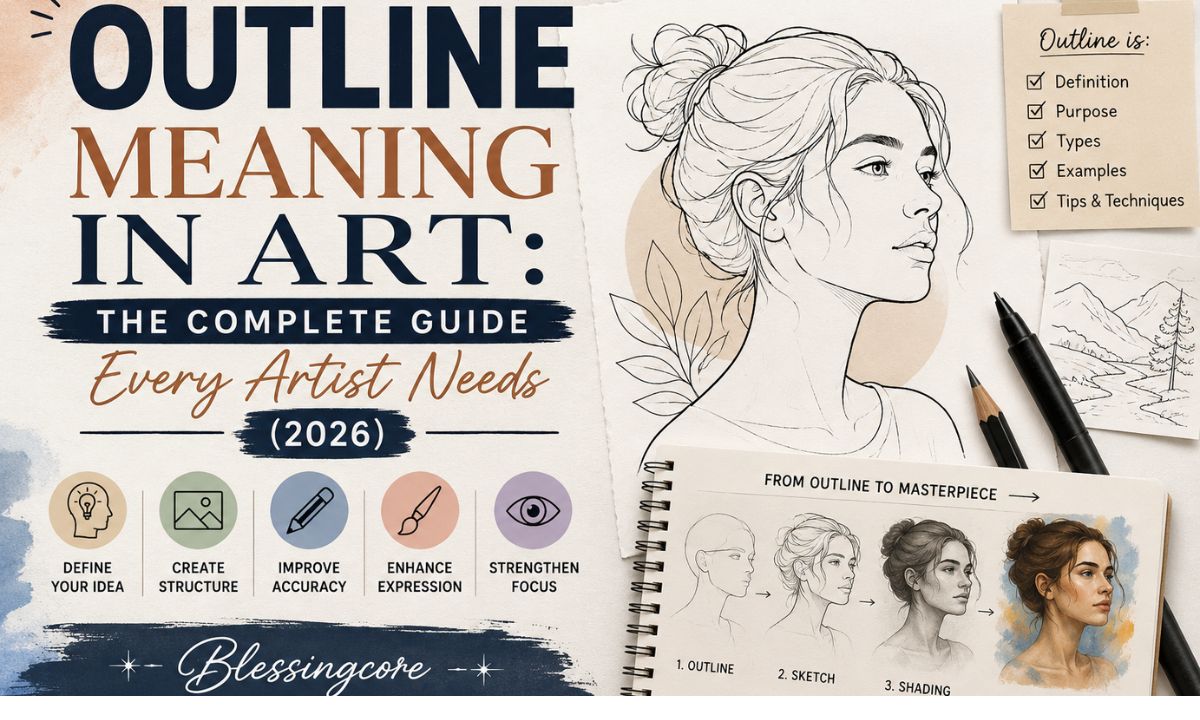
If you’ve ever picked up a pencil and made that first defining mark on paper, you’ve already worked with the concept without knowing it. Outline meaning in art is one of those foundational ideas that gets glossed over in most tutorials, yet it shapes every drawing, illustration, painting, and design you’ll ever create.
Whether you’re a total beginner or someone who’s been sketching for years, truly understanding what an outline does — and how to control it — changes everything about the way you make art.
This guide from Blessingcore breaks down outline meaning in art from the ground up: its history, its types, its role across mediums, and the techniques that separate artists who struggle from those who produce confident, polished work.
What Is Outline Meaning in Art? (The Real Definition)
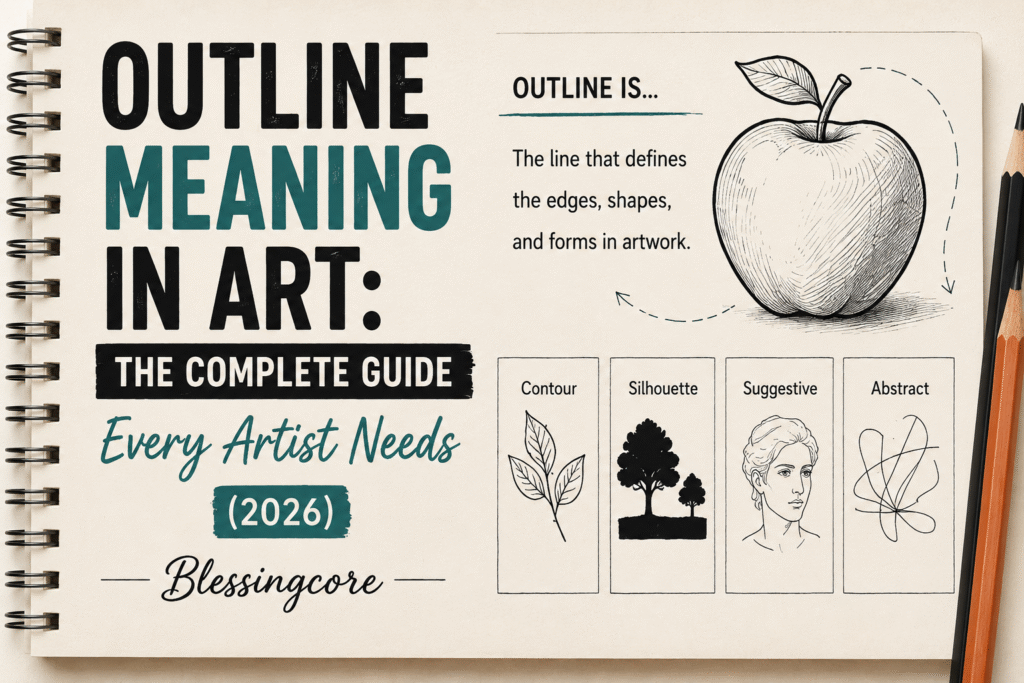
At its simplest, outline meaning in art refers to the line or set of lines that define the outer edge or boundary of a shape, figure, or object in a drawing or painting. It’s the visual boundary that separates one form from another — the line that tells your eye where a face ends and the background begins, or where a building stops and the sky takes over.
But that’s only the surface definition. In practice, outline in art serves as the skeleton of a composition. Before any color, shading, texture, or detail is added, the outline establishes structure, proportion, and form. It’s the artist’s first conversation with the canvas.
Here’s how it differs from how the word is used casually:
| Common Use | Art-Specific Meaning |
| “Give me an outline of the plan” | A rough structural sketch before detail |
| “She outlined the problem” | The line defining an object’s perimeter |
| “An outline document” | A foundational framework for the composition |
In formal art education, the outline meaning in art extends beyond just the outer edge. It includes how line weight, continuity, and character communicate depth, mood, and intention — not just shape.
A Short History of Outline Meaning in Art (And Why It Matters Now)
Outline is one of humanity’s oldest artistic tools. The cave paintings at Lascaux and Altamira — over 17,000 years old — show animals defined by simple, powerful contour marks. Early humans understood instinctively that a line around a shape communicates form.
Ancient Egyptian art used rigid, formal outlines to denote hierarchy and meaning. Greek vase painters refined the contour into something elegant and rhythmic. During the Renaissance, masters like Leonardo da Vinci elevated outline into a sophisticated study of anatomy and proportion, while also developing sfumato — a technique of deliberately softening and dissolving outlines to create atmospheric depth.
The 20th century brought a full rebellion. Impressionists loosened the line. Abstract artists like Kandinsky argued that line carried emotion independent of form. Pop artists like Andy Warhol used bold, graphic outlines as a stylistic signature — his blotted line technique became iconic for its deliberate imperfection.
Today, with the explosion of digital art, illustration, and design, understanding outline meaning in art is more relevant than ever. Procreate tutorials go viral on YouTube, character design is a professional career path, and outline control separates amateurs from professionals on every platform from Instagram to Behance.
The Role of Outline Meaning in Art
Among the seven elements of art — line, shape, form, space, texture, value, and color — line is the element most directly tied to outlining. But outline meaning in art touches several elements simultaneously:
- Line: The outline is a type of line, specifically one that defines edges.
- Shape: Without an outline, a shape has no boundary. The outline creates the shape.
- Form: When outlines use varying weights or suggest volume, they begin to describe 3D form on a 2D surface.
- Space: Outlines separate objects from backgrounds, establishing positive and negative space.
Understanding this interconnected role helps artists see outline not as a simple first step, but as a decision that influences the entire composition.
Types of Outline Meaning in Art: A Complete Breakdown
Not every outline works the same way. The type of outline an artist chooses communicates entirely different things. When students and professionals research outline meaning in art, this is where the subject gets genuinely interesting — there isn’t one universal outline, there are many. Here’s a breakdown of the major types you’ll encounter.
Contour Outline
A contour outline traces the edge of a form precisely and carefully, following the actual curves and details of the subject. This is the most “faithful” kind of outline — it describes what is actually there.
A classic exercise: blind contour drawing, where you draw the outline of a subject without looking at your paper. This builds hand-eye coordination and forces you to observe more deeply than usual. Art teachers assign it precisely because it breaks bad habits of drawing from memory rather than observation.
Contour outlines vary in precision. A simple contour captures just the outer silhouette. A modified contour picks up some internal edges for added detail. A cross-contour wraps around the form’s surface to suggest volume — think of topographic lines on a map.
Continuous Outline
A continuous outline (or continuous line drawing) is produced without lifting the pen or pencil from the surface. The result is a flowing, uninterrupted mark that often has an organic, energetic quality.
Real-life use:
- Fashion illustration relies heavily on continuous line for its fluid, elongated figure drawings
- Caricature artists often use this approach for speed and stylistic flair
- It’s a common warm-up technique in figure drawing classes worldwide
The line quality in continuous outlines tends to feel alive — it wobbles, thins, and thickens as the hand moves, which reads as natural and dynamic to the eye.
Broken Outline Meaning in Art
A broken outline is exactly what it sounds like: a line that deliberately stops and starts, leaving intentional gaps. Rather than weakening the form, these gaps often create a more dynamic, textured result. The viewer’s eye fills in the missing sections, a phenomenon known in psychology as closure.
Where you see broken outlines:
- Impressionist and Post-Impressionist drawings
- Manga and comic art (to suggest shadow without heavy shading)
- Loose sketches and gestural studies
- Architectural rendering, where gaps suggest light hitting an edge
Sketch Outline Meaning in Art
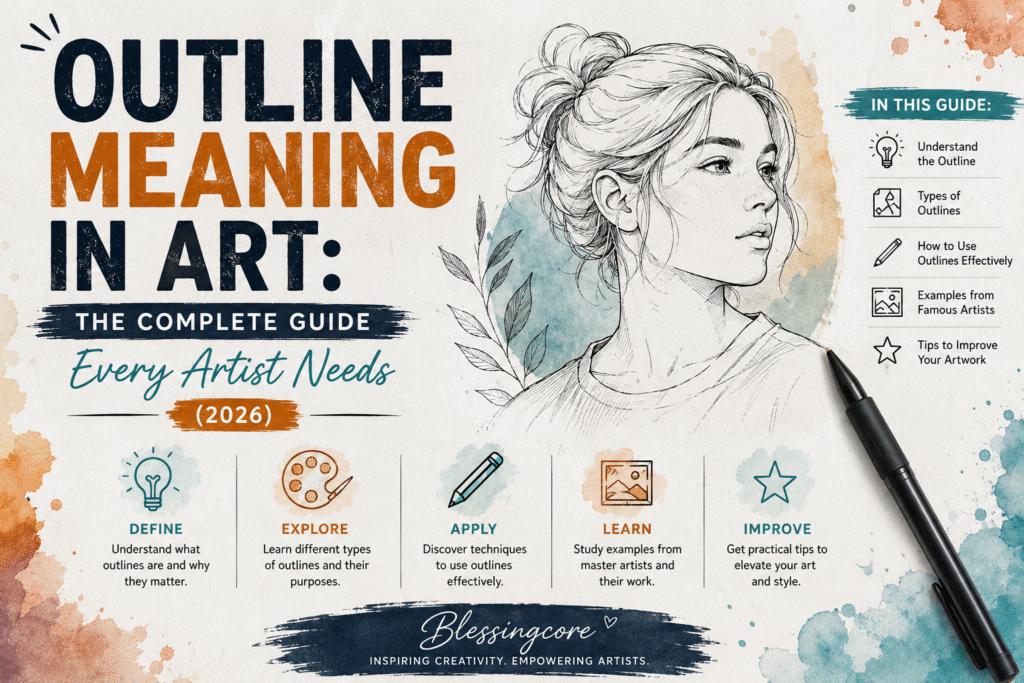
A sketch outline is the loose, exploratory line made when an artist is still working out a composition. It’s not meant to be final — it’s a working document, a thinking-through-drawing process.
Key characteristics:
- Multiple overlapping lines searching for the right edge
- Light pressure, easy to erase or revise
- Often messy, with “hairy” edges from repeated strokes
- Foundation for tighter, more refined work later
Sketch outlines are incredibly useful. Most professional illustrators and animators start here before committing to cleaner linework.
Expressive or Gestural Outline Meaning in Art
An expressive outline prioritizes emotion and energy over accuracy. The line might be scratchy, urgent, trembling, or wildly varied in weight. Egon Schiele is the master example here — his figures twist, his lines drag and press, and the result is raw psychological intensity. The contour doesn’t just describe the body; it feels like the body.
Gestural outlines are usually drawn quickly, capturing the movement and mood of a pose rather than its anatomical precision. This is the go-to approach for life drawing warm-ups and for any artwork where energy matters more than polish.
Geometric Outline Meaning in Art
A geometric outline uses clean, precise shapes — circles, rectangles, triangles — as the foundational boundaries of a composition. This approach is common in:
- Logo and brand design
- Architectural illustration
- Abstract and constructivist art (think Mondrian’s rigid grid of black lines)
- Technical and instructional drawing
Geometric outlines communicate clarity, order, and professionalism. They’re the backbone of most UI/UX design work and icon sets.
Silhouette as Outline
A silhouette is the ultimate outline — a completely filled shape with no internal detail, defined entirely by its outer edge. The silhouette as outline forces an artist to think about the recognizability of a form at its most stripped-down.
The silhouette test is a classic design check: if a character or object reads clearly as a solid shape, the outline design is strong. If it’s ambiguous, the form needs rethinking. This is a standard step in character design for animation and games.
Outline vs. Contour Line — Clearing Up the Confusion
This is one of the most common questions in art education, and the answer matters:
| Outline | Contour Line | |
| Focus | Outer edge only | Both outer edge AND surface details |
| Detail level | Simplified | More descriptive |
| Volume | Doesn’t suggest volume | Can imply 3D form |
| Complexity | Simple, clean | Nuanced, layered |
| Use | Establishing basic shape | Defining form in depth |
In everyday conversation, the two terms get used interchangeably — and in casual contexts, that’s fine. But technically, a contour line includes things like the crease of a sleeve, the inner edge of a nostril, or the fold of fabric. An outline stays at the perimeter.
When art teachers say “draw the outline,” they usually mean the outer silhouette. When they say “do a contour study,” they want you tracing every edge and surface variation you can observe.
How Line Weight Transforms anOutline Meaning in Art
Line weight — the variation in thickness of a line — is arguably the most powerful tool in outline control. This aspect of outline meaning in art is often underestimated by beginners, yet professionals rely on it constantly. A uniform, unvarying outline looks flat and robotic. Strategic weight variation gives a drawing life, depth, and hierarchy.
Why it works:
- Thick lines push forward visually; they feel heavier, closer, more dominant
- Thin lines recede; they feel lighter, more distant, or more delicate
- Varying weight within a single outline simulates the effect of light and shadow without adding shading
The conventional rule: lines in shadow or on the bottom/grounded areas of a form go thicker. Lines facing light sources or at the top go thinner. This creates an immediate sense of dimension.
Quick practice drill:
- Draw a simple object — an apple, a mug, a shoe
- Use only outline, no shading
- Make all lines facing upward thin (hairline or 0.3mm equivalent)
- Make all lines facing downward or at the base thick (0.8–1mm equivalent)
- Compare with a version where all lines are the same weight
The difference is dramatic. Most beginners don’t do this, which is why their outlines look flat.
Outline Techniques Across Different Art Mediums
Drawing (Pencil, Pen, Charcoal)
Drawing is where most people learn outline meaning in art for the first time, and it’s where the most direct control exists.
Best tools for outline drawing:
- HB–2H pencils for light structural outlines
- 0.1–0.5mm fineliners for clean ink outlines
- Brush pens for expressive, pressure-sensitive outlines
- Charcoal for dramatic gestural work
- Ballpoint pens for varied-weight continuous lines
Painting (Oil, Watercolor, Acrylic)
Outlines in painting are more complex because they’re rarely drawn as explicit lines. Instead, painters create “implied outlines” through contrast — placing a light value next to a dark one to define an edge.
Some painters do use literal outlines. Fauvists like Matisse used bold, simplified color-bounded outlines. Expressionists used raw, dragged brushstrokes as outline. In children’s educational painting, outlines are often drawn in resist medium (wax or masking fluid) before watercolor is applied.
Digital Art
Digital outlining is now one of the most common applications of outline meaning in art, thanks to apps like Procreate, Clip Studio Paint, and Adobe Fresco.
Vector vs. raster outlines:
| Vector Outline | Raster Outline | |
| Made of | Mathematical paths | Pixels |
| Scalability | Infinite, no quality loss | Loses quality when scaled up |
| Best for | Logos, icons, clean illustrations | Painterly digital art, textures |
| Tools | Adobe Illustrator, Affinity Designer | Procreate, Photoshop, Clip Studio |
Digital artists can adjust line weight, opacity, and texture after the fact — a huge advantage over traditional media. Custom brushes allow digital outlines to mimic any traditional tool with impressive accuracy.
Printmaking
In woodblock, linocut, and etching, outlines are carved or etched into the printing surface. The outline becomes the ink-carrying groove. Japanese woodblock prints (ukiyo-e) are famous for their precise, expressive outlines — the keyblock that prints the black lines is cut first, and everything else is built around it.
Famous Artists Who Redefined the Outline Meaning in Art
Understanding outline meaning in art is richer when you see how masters have used it:
- Henri Matisse — His late-career line drawings capture full human figures and expressions with astonishing economy. His flowing, unbroken outlines communicate emotion without any shading at all.
- Egon Schiele — Angular, tortured outlines that seem to vibrate. His contour work is psychological rather than decorative, full of raw human tension.
- Pablo Picasso — Known for single-line animal sketches that required him to capture the entire essence of a form in one unbroken movement.
- Keith Haring — Bold, graphic, uniform outlines applied to public murals and commercial art, making his figures instantly recognizable across cultures.
- Andy Warhol — Developed the blotted line technique: drawing in ink on one surface, blotting it onto another while wet. The resulting outlines had a deliberately imperfect, hand-made quality that became his commercial illustration signature.
- Piet Mondrian — Used strong black geometric outlines as the structural foundation of his De Stijl compositions, reducing art to its most essential grid.
Common Mistakes Artists Make with Outline Meaning in Art
Even experienced artists fall into these traps:
- Uniform line weight throughout — Every line the same thickness creates a flat, lifeless drawing. Vary your weight intentionally.
- Outlining before understanding the form — If you don’t understand 3D structure, your outline will be a symbol of an object, not a representation of one.
- Making outlines too dark too soon — Starting with heavy ink or hard pressure leaves no room to correct proportions. Start light.
- Ignoring negative space — The shape around your subject matters as much as the outline itself. Strong outlines define both.
- Over-relying on outlines in painting — In oil or watercolor, outlining everything can kill the naturalistic quality. Let edges breathe; not every form needs a hard line.
- Tracing as a substitute for learning — Tracing gives you a shape, but not the understanding of why that shape is correct. Use reference actively, not passively.
How to Practice and Improve Your Outline Meaning in Art
Consistent, deliberate practice is the only path forward. Here are proven exercises:
- Daily contour studies (10–15 minutes): Pick any object near you and draw it in contour without lifting your pen. Do this every day for a month.
- Blind contour drawing: Forces you to actually observe rather than draw from memory.
- Timed gesture sketches: Thirty-second to two-minute figure poses train your hand to find the essential outline fast.
- Line weight exercises: Draw the same object three times — thin only, thick only, varied weight. Compare results.
- Copy master outlines: Study how Schiele, Matisse, or Haring place their lines, then recreate their work to understand their decisions.
- Draw through forms: Sketch objects as if they were transparent, drawing both the visible and hidden edges. This builds spatial understanding.
Outline in Art Education: Why It’s Always Taught First
Every art curriculum — from elementary school to professional art colleges — begins with outline. Grasping outline meaning in art early sets the stage for every other skill a student develops. This isn’t arbitrary. There are clear pedagogical reasons:
- Outline is observable: Edges exist in reality. Beginners can see where a cup ends and the table begins. Teaching observation starts with outline.
- It establishes proportion: Before color or value enters, outline fixes whether the shapes are correctly sized and placed.
- It’s forgiving: Pencil outlines can be erased and corrected. They’re a low-stakes way to practice fundamental perception skills.
- It translates across all mediums: Whether a student moves into painting, sculpture, graphic design, or digital illustration, the understanding of form-defining edges remains essential.
Blind contour, contour studies, and gesture drawing are the holy trinity of foundation drawing courses precisely because they train the eye-hand-brain pipeline that underlies all visual art.
Real-Life Examples of Outline in Action
Example — Character Design Workflow (Digital Art)
A professional character designer working in Procreate typically follows this sequence:
- Rough sketch outline — Loose, light-pressure strokes establishing proportions and pose
- Structure pass — Tighter outlines clarifying anatomy and form overlaps
- Clean line art — Final, confident ink-weight-varied outlines on a new layer
- Color fill — Applied beneath the outline layer
- Shading — Added on top, often without additional outline adjustment
The entire workflow is structured around the outline. Color and shading support it; they never replace it.
Example — Architectural Drawing
Architects use outline meaning in art in a highly systematic way. Line weights in architectural drawings are strictly standardized:
- Thick lines: Cut elements (walls, columns) that have been sliced through in plan or section
- Medium lines: Visible edges of objects within the space
- Thin lines: Distant elements, texture indication, grid lines
This hierarchy of outline weights communicates spatial depth and construction information simultaneously — precision that a uniform line could never achieve.
Fashion Illustration Example
Fashion illustrators use elongated, gestural outlines to present garments in motion. The body is often simplified to a near-abstract silhouette, while the clothing details — seams, drape, fabric behavior — are rendered with precise contour lines. The contrast between the simplified figure outline and the detailed garment contour is what makes the clothing pop visually.
Conclusion
Outline meaning in art is far more than just “the line around a shape.” It’s the foundation of visual communication — the first decision an artist makes and often the most powerful one.
From the cave walls at Lascaux to Matisse’s flowing figure studies to the character designs powering today’s animated films, the outline has always been how humans translate the world they see into the world they make.
At Blessingcore, we believe understanding the fundamentals changes everything. When you know how outlines work — what makes them flat or dynamic, stiff or expressive, simple or complex — you stop making marks by accident and start making them with intention.
Frequently Asked Questions
What is the difference between an Outline Meaning in Art and a contour in art?
An outline traces only the outer edge of a form. A contour line traces both the outer edge and internal surface details — like the curve of a cheekbone or the fold of a sleeve — giving a much richer sense of volume and depth.
Do professional artists still use outlines?
Absolutely. From character designers and illustrators to architects and fashion designers, outlines remain a core professional tool. Even painters who work without literal lines rely on implied outlines created through edge contrast.
Should beginners start with Outline Meaning in Art when learning to draw?
Yes — outline drawing is universally taught first because it trains observation, proportion, and hand control. It gives beginners a clear, concrete skill to develop before adding complexity.
What is a blind contour drawing and why do art teachers assign it?
Blind contour drawing means drawing the outline of a subject without looking at your paper. Teachers assign it to force students to truly observe their subject instead of drawing from memory or habit — it’s one of the fastest ways to improve observational accuracy.
How do I make my outlines less stiff and more expressive?
Draw faster, apply varied pressure, and practice gesture drawing regularly. Stiffness usually comes from drawing slowly and carefully — loosening up with timed exercises (30-second poses) trains your hand to move more fluidly.
Must Read
375-ice-puns-short-one-liners-for-adults-names

Sophia, Mia is an experienced content writer with 500+ published articles on national and international platforms, specializing in SEO-focused, well-researched, and high-quality digital content.