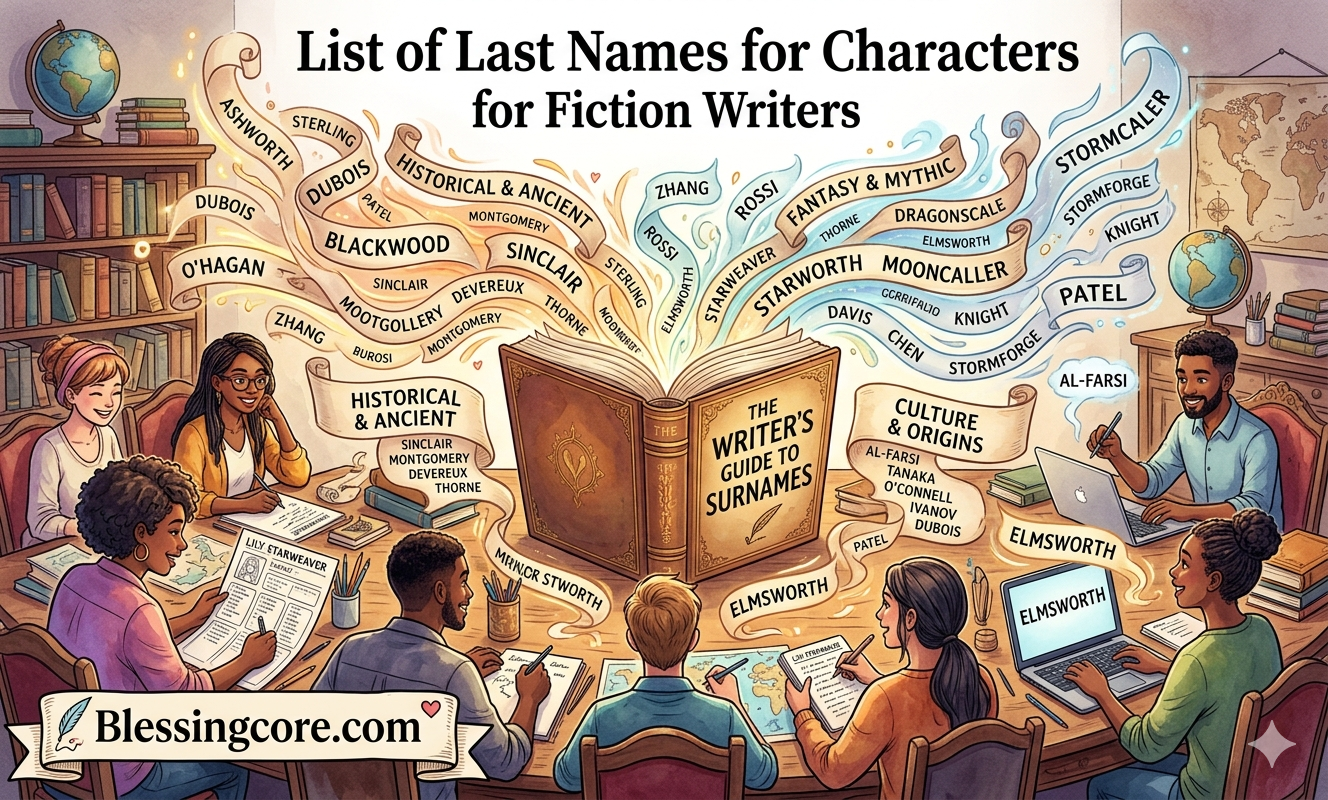
Coming up List of Last Names with the right surname for your fictional character can be just as challenging as plotting your next chapter. Whether you are writing a sweeping fantasy epic, a gritty crime thriller, or a heartfelt romance novel, your character’s surname carries silent weight — it hints at heritage, personality, and social standing before a reader even finishes the first page.
At Blessingcore, we know how much these small details matter to a writer’s creative process. That’s why we put together this complete list of last names for fiction writers, organized by style and origin so you can find the perfect fit faster.
A great surname does more than fill a blank on a character sheet. It anchors your story world, supports your genre’s tone, and helps readers remember who they’re rooting for — or against.
Below you’ll find a curated list of last names broken into four categories: non-modern, traditional, international, and inventive. Use them freely, mix and match, or let them spark your own original ideas.
Non-Modern Surname Ideas
If your story is set in a historical period, a fantasy realm, or an alternate timeline, you’ll want surnames that feel rooted in the past. Non-modern last names often draw from occupational roots, geographical features, or old patronymic systems — where a child took the father’s given name as a family name.
This list of last names pulls from medieval English, Old Norse, and early European naming traditions.
Some excellent non-modern surname ideas for your fiction characters include:
| Surname | Origin / Feel | Best For |
| Ashcroft | Old English — near the ash trees | Historical, Gothic fiction |
| Dunmore | Gaelic — dark fortress | Medieval fantasy, Highland settings |
| Halfpenny | Old English — coin-related trade | Victorian-era stories |
| Ironside | Old Norse — strength and battle | Epic fantasy, war narratives |
| Merriweather | Middle English — pleasant weather | Period romance, country tales |
| Ravenswood | Old English — raven’s woodland | Dark fantasy, Gothic horror |
| Thatcherly | English — thatch-roof craftsman | Pre-industrial settings |
| Wulfric | Old English — wolf ruler | Viking age, early medieval fiction |
These non-modern surnames carry a built-in atmosphere. When a reader encounters a name like Ravenswood or Ironside, they immediately sense the era and tone of your story without any additional explanation — a quiet form of world-building that top fiction writers use expertly.
Traditional
Sometimes a story calls for a grounded, believable surname that feels lived-in and real. Traditional last names are the backbone of contemporary fiction, family dramas, literary novels, and any narrative set in the recognizable modern world.
This list of last names draws from commonly used English, Irish, Scottish, and European family names that carry a natural, authentic resonance.
Traditional surnames that work well for fiction characters:
| Surname | Cultural Root | Character Archetype |
| Calloway | English/Irish | Small-town hero, working-class protagonist |
| Donovan | Irish Gaelic | Charming rogue, big-city detective |
| Fletcher | English — arrow maker | Artisan, quiet and reliable lead |
| Hargrove | English | Wealthy heir, estate owner |
| Langford | English — long ford | Scholarly type, rural background |
| Mercer | English — cloth merchant | Merchant class, morally complex |
| Norwood | English — northern forest | Outsider, quiet and mysterious |
| Pemberton | English — settlement on a hill | Upper-class, aristocratic figures |
| Sinclair | Scottish-French origin | Sophisticated antagonist or lead |
| Whitmore | English — white moor | Clean-slate protagonist |
Traditional surnames work especially well for literary fiction and contemporary drama because they feel familiar to the reader without being distracting. If your goal is immersion, a well-chosen common surname keeps readers in the story rather than pulling their attention toward an unusual name.
International
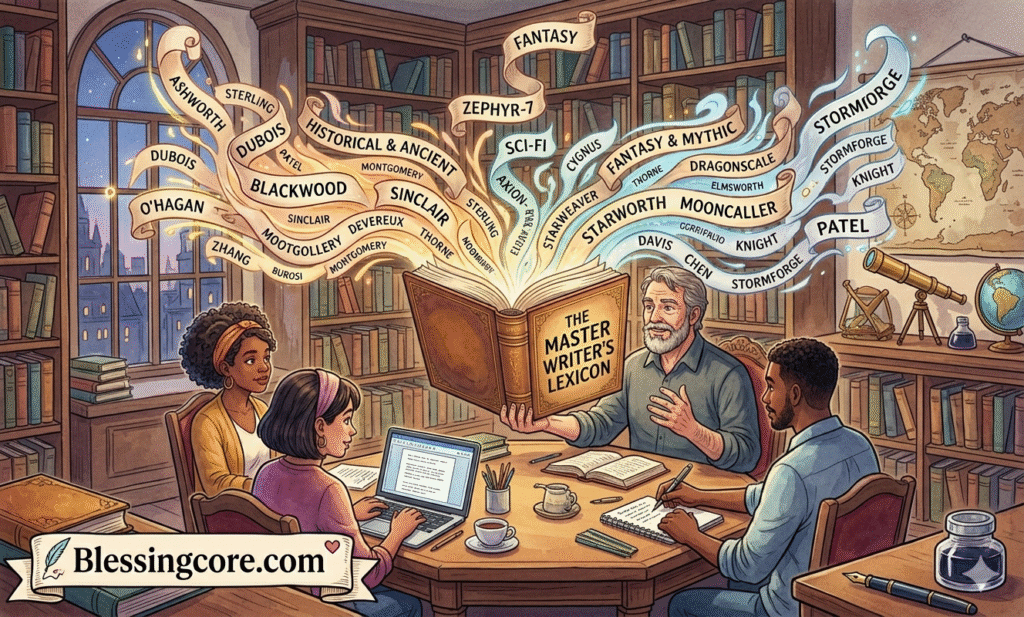
Great fiction is global, and your character’s list of last names should reflect that diversity. International surnames add cultural depth, signal a character’s ethnic heritage, and broaden the world of your story.
When choosing a non-English surname, make sure it matches the character’s background and the narrative context — a mismatch can feel jarring or inauthentic.
Here is a curated list of last names from around the world, organized by region:
| Surname | Origin Country / Region | Meaning or Feel |
| Azevedo | Portuguese / Brazilian | Holly tree; strong and enduring |
| Beaumont | French | Beautiful mountain; elegant, noble |
| Chakraborty | Bengali / Indian | Ancient warrior clan surname |
| Espinoza | Spanish | Thorny place; gritty and determined |
| Fujimoto | Japanese | Beneath the wisteria; poetic and subtle |
| Gallo | Italian / Spanish | Rooster; spirited, confident characters |
| Hashimoto | Japanese | Near the bridge; transitional figures |
| Ivanovic | Serbian / Slavic | Son of Ivan; resilient, Eastern European |
| Kowalski | Polish | Blacksmith descent; working-class grit |
| Okafor | Nigerian (Igbo) | Man came from Afor market; strong legacy |
| Petrov | Russian / Bulgarian | Son of Peter; classic Eastern European |
| Ramirez | Spanish | Son of Ramiro; common, grounded, Hispanic |
| Takahashi | Japanese | High bridge; dependable, prominent figures |
| Vasquez | Spanish | Crow; sharp-minded, mysterious characters |
| Zidane | Berber / North African | Growth and progress; bold, iconic feel |
When writing multicultural stories or fantasy worlds inspired by real-world cultures, this list of last names gives you an authentic starting point. Always research the cultural context of the name you choose to ensure it fits the character’s background and treats that heritage respectfully.
Inventive
For science fiction, high fantasy, dystopian worlds, or any genre where the rules of reality do not apply, you need surnames that feel fresh and invented — names that exist nowhere in the real world but still roll naturally off the tongue. An inventive list of last names is especially useful for protagonists, antagonists, and any character who needs to feel truly one-of-a-kind.
Tips for crafting inventive surnames:
- Blend syllables from two real-world surnames (e.g., Morrow + Ashford = Morrashford)
- Draw from natural elements — storms, minerals, celestial bodies
- Use unusual letter combinations that still feel pronounceable
- Give villains harsher consonants (Krev, Drath, Vorn) and heroes softer sounds (Alwen, Veris, Loran)
| Inventive Surname | Sound Profile | Best Genre Fit |
| Aethon | Bright, ancient-sounding | Epic fantasy, mythology-inspired fiction |
| Blazecroft | Powerful, compound name | Superhero fiction, action-adventure |
| Dawnveil | Ethereal, soft compound | High fantasy, romance fantasy |
| Forsynn | Dark, edgy feel | Dystopian, dark fantasy, villain characters |
| Gravenmoor | Gothic compound | Horror, dark fantasy, haunted settings |
| Keldrix | Sci-fi sharp consonants | Space opera, futuristic fiction |
| Lunaris | Celestial, flowing | Fantasy, cosmic horror, romance |
| Mirefall | Melancholic compound | Literary fantasy, tragedy-tinged stories |
| Stormvane | Elemental, commanding | High fantasy, adventure, warrior leads |
| Thalvex | Alien, otherworldly | Hard sci-fi, alien contact narratives |
| Vexoran | Ominous, mysterious | Villain surnames, thriller antagonists |
| Wyrmcroft | Mythical compound | Dragon-lore fantasy, epic quests |
Inventive surnames work best when they are consistent with the world you are building. If every character in your story has an invented surname, establish a pattern — a phonetic logic — so the naming system feels cohesive rather than random. The list of last names above can spark that pattern and help you build from there.
Wanna Craft Your Own Names?
Sometimes the perfect surname is one that only you can invent. Here at Blessingcore, we encourage writers to develop their own name-crafting instincts because a name you built from scratch will always feel more personal and intentional than one pulled from any list of last names.
Here are practical methods to build your own original character surnames:
1. Use the patronymic method: Take a character’s father’s or mother’s first name and modify it. If the father is ‘Eron,’ the child might be ‘Eronsson’ or ‘Erondaughter.’ This mirrors real historical naming systems and feels organic.
2. Location-based surnames: Name characters after where they are from — a village, a geographical landmark, a notable building. ‘Of the Hollow,’ ‘Hillborn,’ or ‘Crestmere’ all suggest a character’s roots instantly.
3. Occupational roots: Medieval surnames often came from trade — Fletcher (arrow maker), Thatcher (roof builder), Cooper (barrel maker). Invent new occupations for your fantasy world and build names from them.
4. Phonetic blending: Write down five words that describe your character’s personality. Pick strong syllables from each and blend them. A cunning, quiet spy might become ‘Shadowveil’ or ‘Silenthorn.’
5. Reverse or alter real surnames: Take an existing surname, reverse it, drop a vowel, or change one consonant. ‘Carter’ becomes ‘Retrac.’ ‘Stone’ becomes ‘Noest.’ These feel familiar but brand new.
The most important rule when crafting your own list of last names is internal consistency. A name should sound like it belongs in the world you’ve created. Read it aloud — if it trips your tongue, it’ll trip your reader’s mind.
Keep a running name journal as you write, noting patterns that work and ones that don’t. Over time, you’ll develop a naming instinct unique to your creative voice.
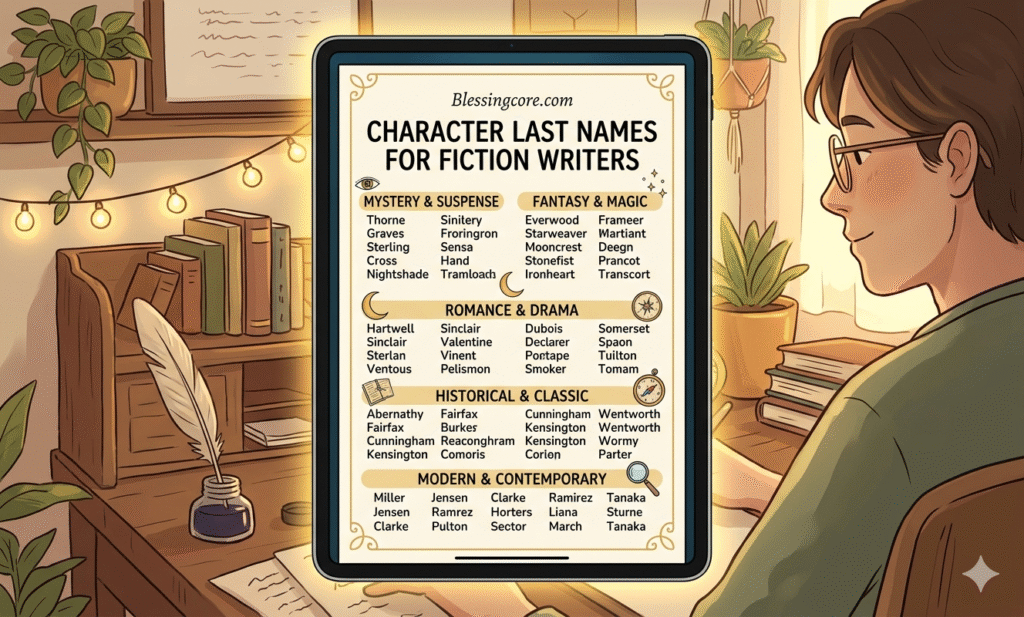
Quick Reference: Choosing the Right Surname by Genre
| Genre | Recommended Surname Style | Example from Lists Above |
| Historical Fiction | Non-Modern or Traditional | Ashcroft, Halfpenny, Pemberton |
| High Fantasy | Inventive or Non-Modern | Dawnveil, Wulfric, Ironside |
| Contemporary Drama | Traditional | Fletcher, Calloway, Sinclair |
| Science Fiction | Inventive or International | Keldrix, Thalvex, Chakraborty |
| Romance | Traditional or International | Hargrove, Beaumont, Whitmore |
| Thriller / Crime | Traditional or Non-Modern | Donovan, Mercer, Ravenswood |
| Multicultural Fiction | International | Okafor, Azevedo, Takahashi |
| Gothic / Horror | Non-Modern or Inventive | Gravenmoor, Dunmore, Forsynn |
Share this Content
Found this list of last names helpful? Share it with a fellow writer, post it in your favorite fiction writing community, or bookmark it for your next character creation session. Good resources are worth passing on.
Similar Research
If you enjoyed this list of last names, you might also find these Blessingcore resources useful for your creative writing projects:
- List of Female Character Names for Fiction Writers
- List of Male Character Names for Fiction Writers
- Unique Middle Names for Fictional Characters
- Fantasy World-Building Name Guides
- Character Personality Archetypes and Naming Conventions
List of Female Character Names for Fiction Writers
Beyond surnames, first names matter enormously for female characters. The right first name paired with a strong surname from this list of last names creates a complete identity that readers will remember.
Female character names can range from classic choices like Eleanor, Adelaide, and Constance to contemporary picks like Nova, Indie, and Sloane — or fully invented fantasy names like Aelindra, Vessa, or Thessaly.
The key is matching the first name’s sound and cultural origin to the surname you’ve chosen so the full name flows naturally and feels like a real person’s name within your story world.
List of Male Character Names for Fiction Writers
Male character first names carry the same weight as the surnames in this list of last names. Strong masculine first names like Callum, Rowan, Evander, and Silas pair well with traditional and non-modern surnames, while invented first names like Threx, Oryn, or Daelion work alongside inventive surnames.
For international male characters, consider names like Emre, Kenji, Rafael, or Tariq, paired with the international surnames listed above for a culturally cohesive character identity that feels authentic and thoughtfully constructed.
Conclusion
A character’s surname is never just an afterthought. It’s one of the first signals you send to your reader about who this person is, where they came from, and what kind of story they inhabit. Whether you pick from the non-modern, traditional, international, or inventive categories in this list of last names — or use our crafting methods to build your own — the goal is always the same: a name that feels inevitable, as if it could never have been anything else.
At Blessingcore, we’re committed to giving fiction writers the practical, creative tools they need to build memorable characters and compelling stories. Save this complete list of last names, explore the related resources in the Similar Research section, and never let a blank name field slow your writing down again.
Frequently Asked Questions
What is the best way to find last names for fictional characters?
Use themed lists categorized by genre, era, or cultural origin — like the ones on Blessingcore — then narrow your choices based on the character’s backstory, personality, and the world they inhabit.
Can I use real surnames for my fictional characters?
Yes, real surnames are commonly used in fiction. Just avoid using the full name (first + last) of a living, real person in a way that could be defamatory or misleading.
How do I create an original surname for a fantasy character?
Blend syllables from descriptive words, use the patronymic or occupational method, or combine natural elements. Always read the result aloud to check that it sounds pronounceable and fits the character’s world.
Should a villain’s last name be different from a hero’s?
Not necessarily, but name sound psychology is real — harsher consonants (K, X, V, R) can subtly suggest menace, while softer sounds (L, M, N, W) feel more approachable. Use this as a creative tool, not a rigid rule.
How many characters can share the same last name in a story?
Related characters (family members) can share surnames intentionally, but unrelated characters with identical or very similar surnames will confuse readers. Always differentiate unrelated characters clearly.
Must Read
hilarious-fat-jokes-and-puns-funny-fat-people-roasts
Sophia, Mia is an experienced content writer with 500+ published articles on national and international platforms, specializing in SEO-focused, well-researched, and high-quality digital content.