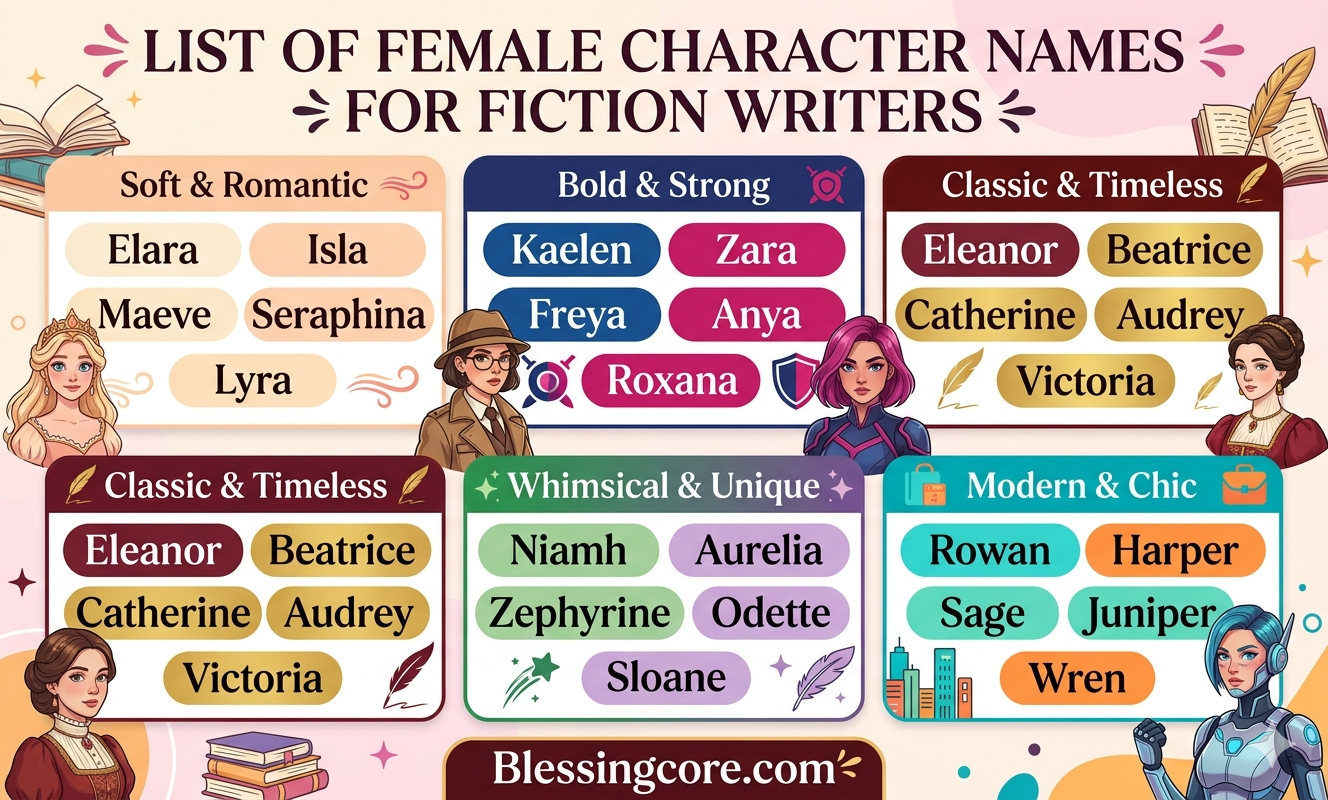
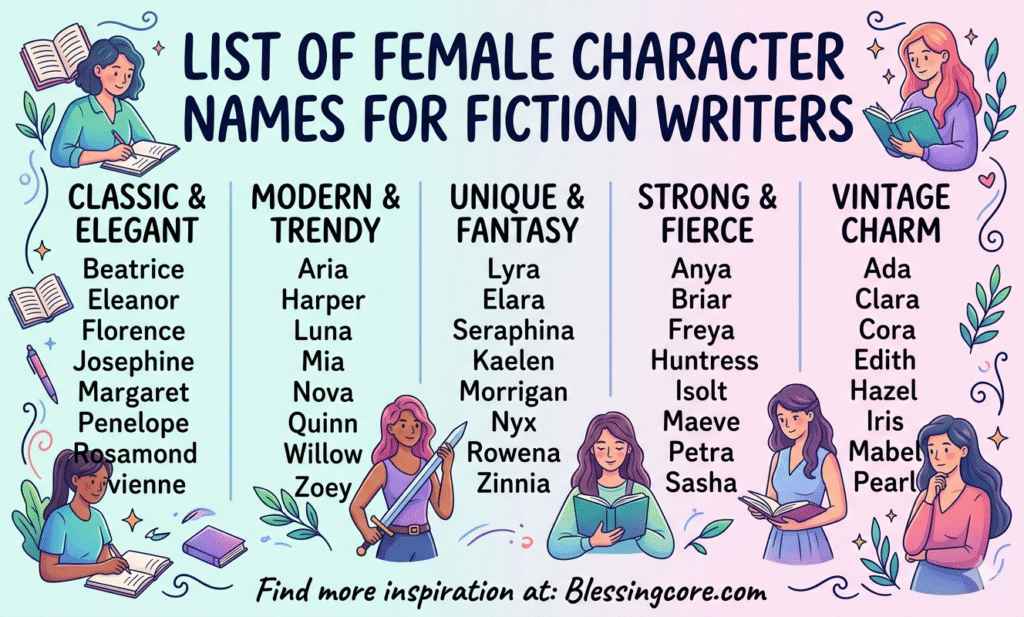
Picking the right list female character names can make or break a story. Whether you are writing a slow-burn romance, a gripping thriller, or a sprawling fantasy epic, the name you choose signals personality, background, and emotional depth before a single line of dialogue is spoken.
At Blessingcore, we have put together this complete list of female character names sorted by category so fiction writers at every level can find what they need fast.
From classic names rooted in history to fresh, inventive picks and mystical fantasy options, this guide covers a wide range. You will also find tips on crafting your own original names when nothing on a ready-made list quite fits your vision.
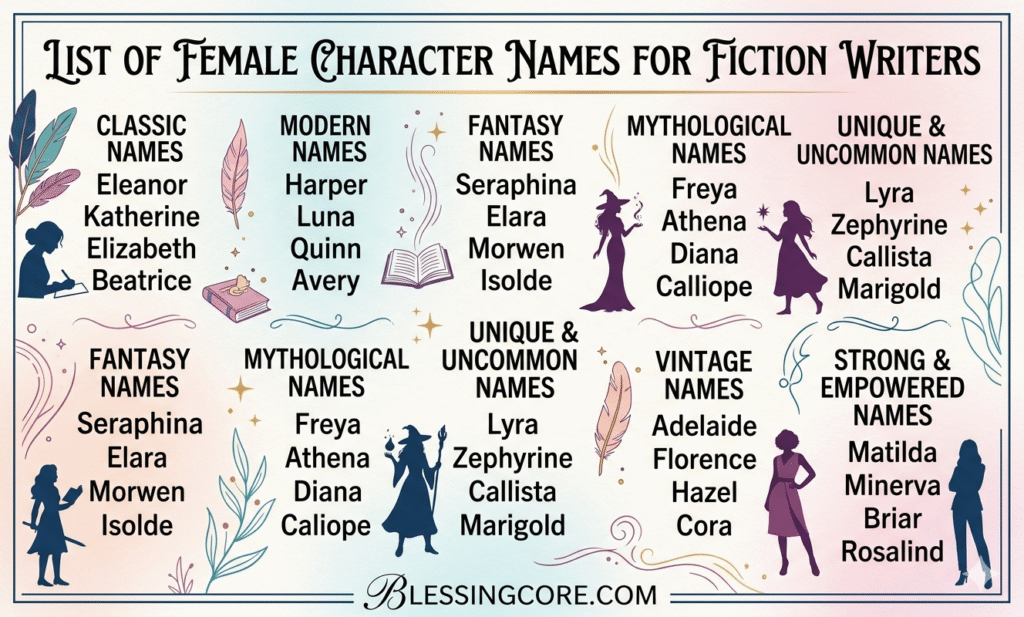
Traditional List Female Character Names
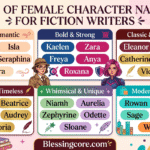
Traditional names carry cultural weight. They feel grounded, familiar, and instantly recognizable to readers. When your character needs to feel like she belongs to a real time and place, a classic name does that work quietly in the background. Below is a curated list of female character names drawn from historical records, classic literature, and timeless naming conventions.
| Name | Origin | Meaning / Character Feel |
| Eleanor | Old French / Greek | Noble; strong-willed protagonist energy |
| Margaret | Greek | Pearl; refined, composed, intelligent |
| Catherine | Greek | Pure; suits royalty, intellectuals, or leaders |
| Harriet | Germanic | Home ruler; determined and grounded characters |
| Josephine | Hebrew | God will increase; resilient heroines |
| Beatrice | Latin | She who brings happiness; classic literary heroine |
| Dorothy | Greek | Gift of God; warm, brave, everyman heroines |
| Florence | Latin | Flourishing; idealistic or compassionate leads |
| Constance | Latin | Steadfast; suits loyal, principled characters |
| Rosalind | Germanic | Gentle horse; poetic, romantic characters |
| Cecilia | Latin | Blind to one’s own beauty; musical or artistic souls |
| Adelaide | Germanic | Noble sort; aristocratic or regal figures |
| Virginia | Latin | Pure; thoughtful, literary, introspective women |
| Clara | Latin | Bright, clear; sharp-minded secondary characters |
| Sylvia | Latin | Forest; nature-connected or quietly poetic women |
Why Traditional Names Work in Fiction
Classic names carry centuries of connotation. A character named Margaret or Eleanor arrives with invisible cultural baggage that readers feel without being told. This is especially useful in historical fiction, literary novels, and contemporary stories where realism matters.
These names also tend to have rich nickname options, giving writers flexibility. Catherine becomes Kate or Cate depending on the personality. Josephine becomes Jo or Josie depending on the era.
Inventive List Female Character Names
Sometimes a story calls for something that sounds real but is not quite something you have heard before. Inventive names occupy that sweet spot between invented and believable. They feel fresh without sounding alien.
This part of our list of female character names leans into creative combinations, unexpected spellings, and names borrowed from mythology, nature, or other languages.
| Name | Inspired By | Best Suited For |
| Vespera | Latin (evening star) | Mysterious, night-world characters |
| Taryn | Modern coinage | Urban fiction, strong young leads |
| Isolde | Celtic mythology | Tragic romances, Arthurian-adjacent stories |
| Cressida | Greek mythology | War narratives, loyalty and betrayal themes |
| Zephyrine | Greek wind god | Free-spirited, untamed protagonists |
| Thessaly | Greek region | Intellectual, otherworldly, witchy characters |
| Odessa | Greek / place name | Wanderers, exiles, seekers |
| Corvin | Latin (raven) | Dark academia, gothic, antihero roles |
| Vesna | Slavic (spring) | Renewal arcs, characters tied to nature cycles |
| Maren | Hebrew / Scandinavian | Coastal stories, calm but deep characters |
| Sable | English (black) | Mysterious, shadowed, morally complex |
| Caelum | Latin (sky/heaven) | Dreamers, prophets, spiritual characters |
| Lyric | English coinage | Creative leads, musicians, poets |
| Nyx | Greek goddess of night | Villains, antiheroes, supernatural beings |
| Reverie | French (daydream) | Introspective, melancholic, artistic women |
How to Use Inventive Names Without Alienating Readers
The biggest risk with creative names is that they pull readers out of the story. If a name looks impossible to pronounce, some readers will mentally stumble every time they encounter it.
A good rule of thumb: say the name aloud. If it flows naturally off the tongue, it will work on the page. Names like Vespera, Maren, and Odessa hit that balance well. They feel distinctive but are phonetically intuitive.
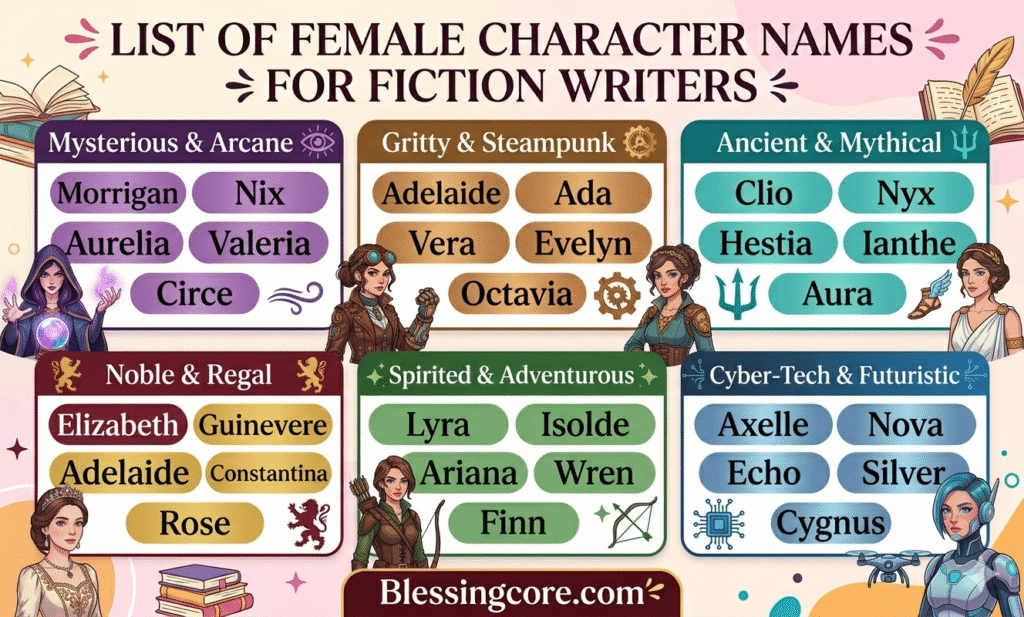
Fantasy List Female Character Names
Fantasy demands names that do not exist in the real world but still feel like they could. The best fantasy names suggest culture, history, and power without a single line of backstory.
This section of our list of female character names is built specifically for world-builders: epic fantasy, dark fantasy, high fantasy, and sword-and-sorcery writers who need names that feel rooted in invented languages and ancient mythologies.
| Name | Sound Profile | Archetype Fit |
| Aelindra | Elvish tones | Elven queens, ancient warriors, seers |
| Seraphyne | Angelic / ethereal | Light mages, divine figures, celestial beings |
| Vorryn | Dark, sharp consonants | Antiheroes, warlords, blood mages |
| Thessara | Ancient Greek feel | Oracles, scholars, high priestesses |
| Caerith | Celtic undertones | Shapeshifters, druids, forest guardians |
| Nyxara | Greek darkness | Shadow assassins, night court figures |
| Emberlynn | Nature / fire blend | Fire wielders, pyromancers, passionate rebels |
| Solvaine | Norse sun roots | Sun priestesses, golden warriors, paladins |
| Zythera | Invented, exotic | Alien queens, other-world rulers |
| Mariveth | Soft yet mysterious | Healer-witches, double-life characters |
| Duskara | Twilight-coded | Twilight or liminal world characters |
| Faelith | Light Elvish | Wandering elf scouts, trackers, spirit-touched |
| Orryn | Short, powerful | Warriors, bounty hunters, swordswomen |
| Cyndara | Fire-smoke blend | Dragon riders, volcano-realm inhabitants |
| Lithowyn | Stone + Welsh | Earth mages, stone giants’ kin, stoic protectors |
Building Fantasy List Female Character Names from Real Language Roots
Most successful fantasy names are not entirely made up. Writers like J.R.R. Tolkien built entire invented languages, and names like Arwen and Eowyn have internal linguistic logic. Even without that level of depth, you can borrow from Old Welsh, Old Norse, Latin, or Ancient Greek to create names that feel culturally coherent. Combining a root word meaning something relevant to your character with common fantasy endings like -yn, -ara, -ith, or -veth can produce names that feel invented but purposeful.
Quick Reference: Fantasy Name Elements
- Prefixes: Ae-, Sel-, Vor-, Ny-, Em-, Sol-, Zy-
- Middles: -ar-, -el-, -ith-, -in-, -eth-, -al-
- Suffixes: -yn, -ara, -veth, -ith, -wyn, -dra, -ra
- Dark tones: Vr-, Nx-, Dr-, Sk-, Gr-
- Light tones: Ae-, El-, Sel-, Lyr-, Sol-
Wanna Craft Your Own Names?
No list of female character names, no matter how long, can perfectly match every story world and character vision. Sometimes the right name has to be invented from scratch. Here is a practical method fiction writers use to create original female character names that feel real and purposeful.
Step 1: Define the Character’s Core Identity
Before you pick syllables, know who this character is. Is she fierce or gentle? Ancient or modern? From a coastal culture or a mountain one? Names tend to reflect environment and personality when they are working well. A desert-culture warrior probably should not have the same naming conventions as a rain-forest healer.
Step 2: Choose a Language or Sound Family
Pick a real or invented language to draw from. Latin and Greek feel classical and weighty. Celtic and Norse feel rugged and ancient. Japanese and Arabic names feel culturally distinct and musical. You do not need to speak these languages; you just need to study the sound patterns and borrow freely.
Step 3: Build Syllables Around Meaning
Decide if the name should carry a hidden meaning. Vespera means evening star. Aelindra might suggest wind and grace. These meanings do not need to be obvious to readers, but they give you, the writer, something to anchor the character to. That internal logic tends to come through in how you write the character.
Step 4: Test Pronunciation Out Loud
Say the name ten times quickly. If it trips you up, it will trip up your reader. Simple consonant-vowel alternation tends to produce naturally speakable names. Compare: Maquilla versus Mzxrvyn. One invites you in; the other pushes you away.
Step 5: Check for Unintended Meanings
Run the name through a few languages. What sounds like a beautiful invented name in English might mean something unfortunate in Spanish, German, or Japanese. A quick search can save you from a distracting reaction from international readers.
Quick Comparison: List Female Character Names Categories at a Glance
| Category | Tone | Best Genre Fit | Examples |
| Traditional | Grounded, familiar | Historical fiction, literary, contemporary | Eleanor, Beatrice, Clara |
| Inventive | Fresh, distinctive | Contemporary, urban fantasy, thrillers | Vespera, Odessa, Sable |
| Fantasy | Otherworldly, epic | High fantasy, dark fantasy, sci-fi | Aelindra, Nyxara, Solvaine |
| Custom Crafted | Unique to your world | Any genre requiring world-building | Your own creation |
Conclusion
A character’s name is the first gift you give your readers. It sets tone, signals culture, and carries emotional weight from the very first mention.
Whether you are pulling from our list of female character names in the traditional section, reaching for something inventive and fresh, or building a fantasy name from elemental sounds, the right choice is always the one that feels true to the character and the world she inhabits.
At Blessingcore, we believe every story deserves a name that fits like a second skin. Bookmark this guide, return to it as your story evolves, and do not be afraid to sit with a shortlist for a few days before committing. The best names tend to announce themselves in their own time.
Frequently Asked Questions
What makes a good List Female Character Names?
A good name is easy to pronounce, fits the story’s world and tone, and subtly reflects the character’s personality or cultural background. It should feel like it belongs to the story without distracting from it.
How many List Female Character Names should I consider before choosing?
Most writers shortlist five to ten options and test them in early drafts. Reading the name in context, rather than in isolation, usually reveals the right fit quickly.
Can I use real historical names in fantasy settings?
Yes, and many successful fantasy novels do exactly this. Names like Isolde, Cassandra, and Vivienne feel fantastical but are rooted in real history or mythology, which gives them believable depth.
Should a character’s name reflect her personality?
It helps but is not required. Some writers prefer a deliberate contrast, like naming a fierce warrior something soft, to create interesting subtext. Both approaches can work well.
Where can I find more List Female Character Names ideas?
Blessingcore regularly publishes curated name lists and character-building resources for fiction writers. Historical census records, mythology databases, and baby name sites filtered by origin are also excellent sources for fresh ideas.
Must Read
hilarious-fat-jokes-and-puns-funny-fat-people-roasts
Sophia, Mia is an experienced content writer with 500+ published articles on national and international platforms, specializing in SEO-focused, well-researched, and high-quality digital content.