You get a IDT meaning in text. It says: “idt.” Three letters. Zero context. And now you’re sitting there trying to figure out if you just got rejected, gently disagreed with, or if your friend is simply running low on keyboard effort.
This happens thousands of times a day. And it happens because “idt” is one of those abbreviations that looks deceptively simple — until it isn’t. The tone shifts completely depending on who sends it, on which platform, and what came right before it in the conversation.
At Blessingcore, we break down the slang terms that actually matter in 2026 digital communication. So here’s your complete, no-fluff guide to what “IDT” really means in text — every context, every platform, every tone, and every smart way to respond.
What Does “IDT” Actually Mean in Text?
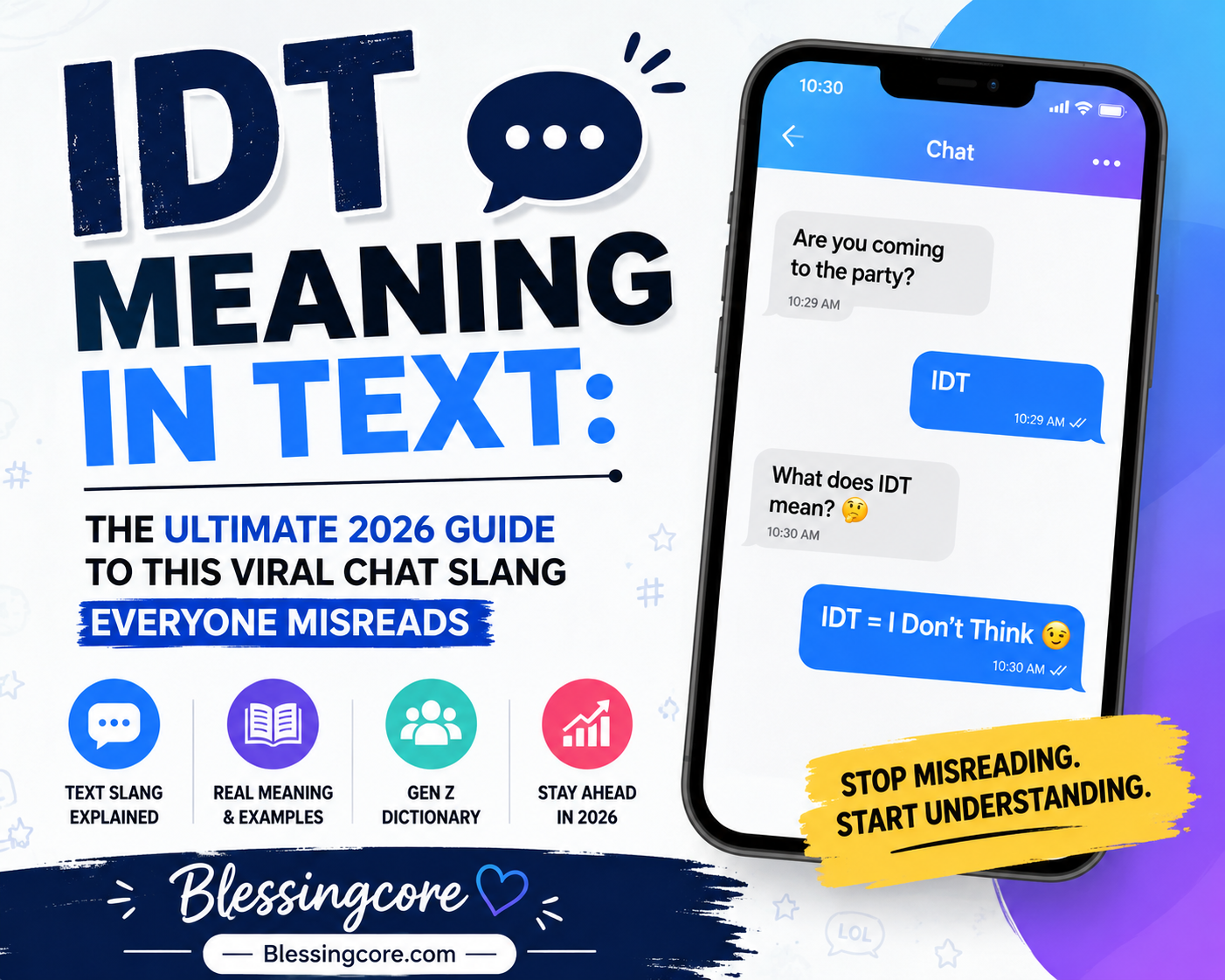
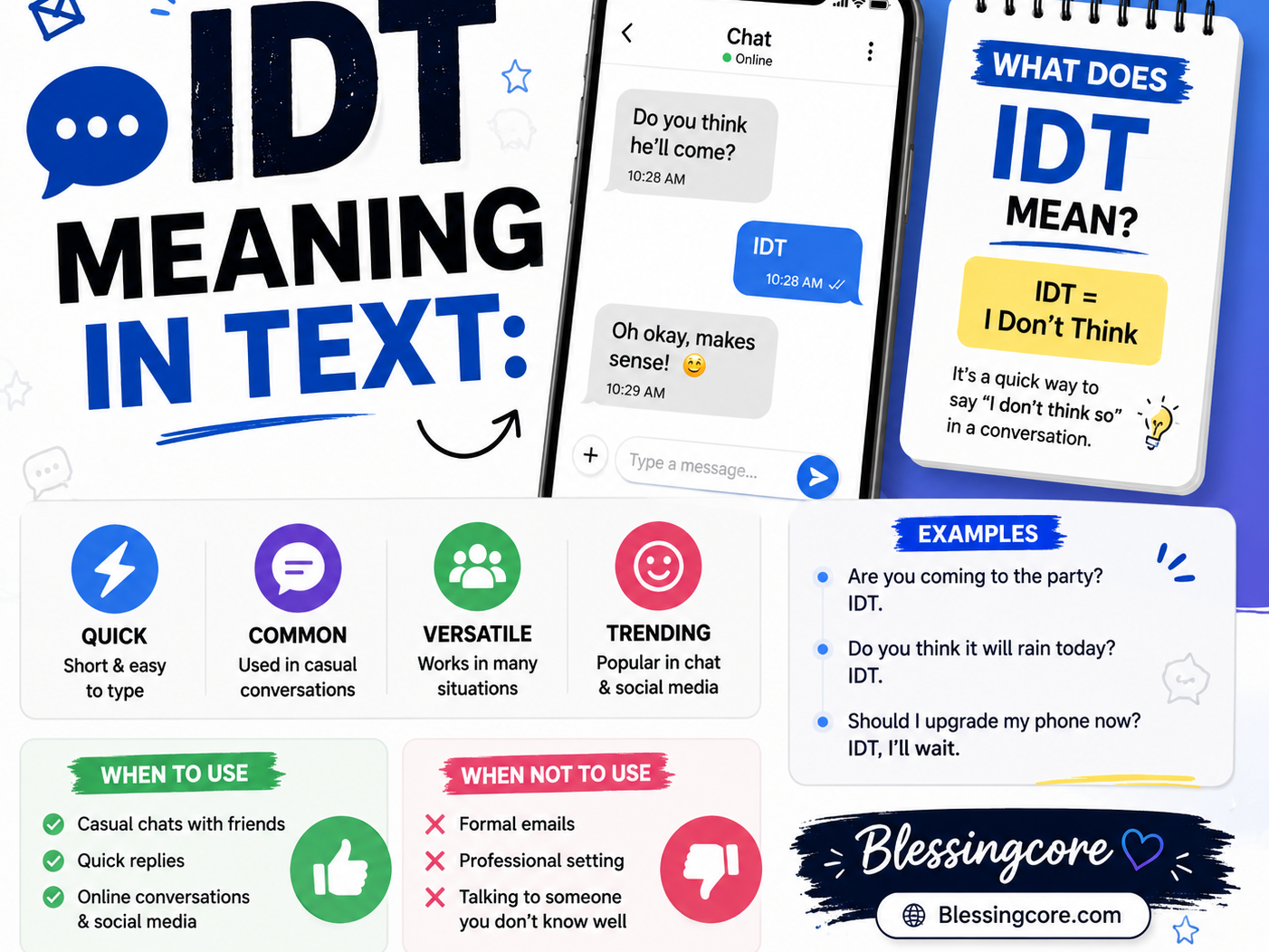
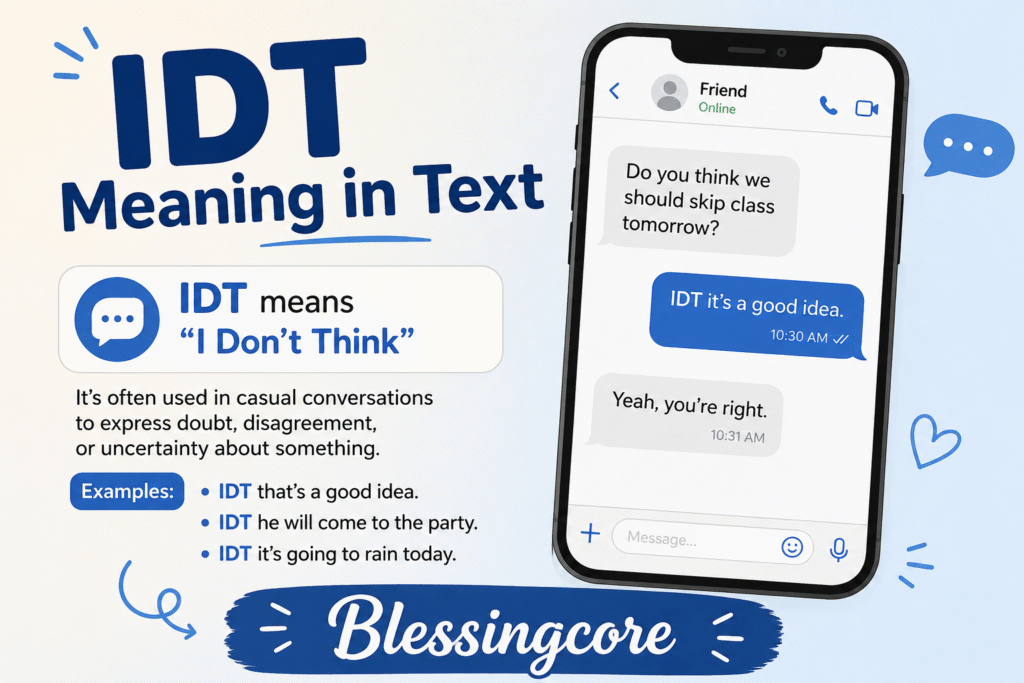
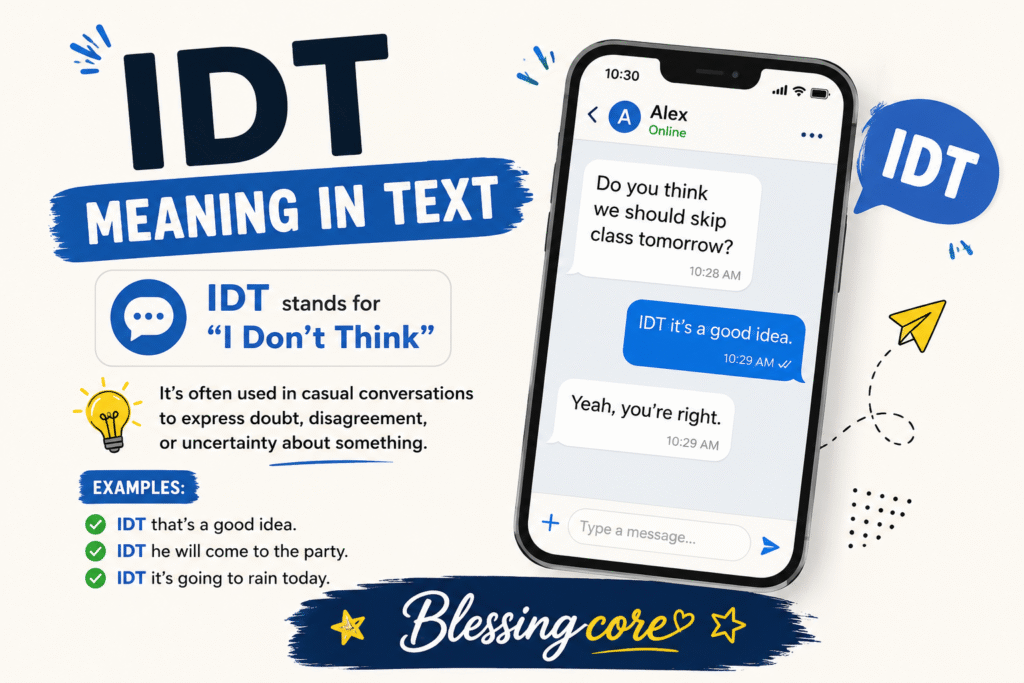
IDT stands for “I Don’t Think.” It’s a quick shorthand people use to express doubt, mild disagreement, or uncertainty in casual digital conversations. Most of the time it appears in lowercase — “idt” — because people type it fast, without stopping to hit Shift.
Quick answer for featured snippet: IDT means “I Don’t Think” or “I Don’t Think So.” It expresses doubt, hesitation, or soft disagreement in casual texting and online chats. The tone depends entirely on context.
The abbreviation works almost like a verbal shrug. It doesn’t shut the conversation down — it keeps things open while letting the other person know you’re not fully on board. That’s what makes it so popular across age groups and platforms in 2026.
IDT belongs to the same family of texting shortcuts as IDK (I Don’t Know), IMO (In My Opinion), and TBH (To Be Honest). These aren’t slang from a specific subculture — they’re just digital shorthand that saves keystrokes in fast-moving conversations.
Every Meaning of “IDT” — Ranked by How Often People Actually Use It
Most slang terms have one core meaning and a handful of edge cases. IDT meaning in text is no different. Here they are, ranked by actual frequency of use in 2026 texting culture.
“I Don’t Think” — The Everyday Default
This is IDT meaning in text home base. The vast majority of uses you’ll encounter fall into this category. Someone asks a question or makes a statement, and the reply is a quick “idt” — short for the full phrase “I don’t think [that’s right / that’ll happen / that’s true].”
| Situation | Example Message | What IDT Means Here |
| Friend asks about plans | “We leaving at 8?” → “idt, probably later” | Expressing doubt about the timing |
| Group chat debate | “That movie was top 5 all time” → “idt lol” | Soft disagreement with the opinion |
| Checking on info | “Was the deadline Monday?” → “idt, check again” | Uncertainty, not outright denial |
“I Don’t Think So” — The Polite Pushback
When IDT meaning in text functions as a complete answer — not the opener to a longer thought — it typically means “I don’t think so.” This version is slightly more final, though still gentle. It’s a soft no without the bluntness of a flat-out rejection.
Example: “Are you coming to the party Saturday?” → “idt ��”
Here IDT meaning in text doesn’t need a follow-up. The emoji does the emotional softening. The message communicates a likely “no” while keeping the door cracked for further conversation.
Low Confidence / Tentative Agreement
Less commonly, IDT can signal hesitant agreement. Instead of disagreeing with a statement, the sender doubts their own certainty — “I don’t think… but I might be wrong.” This is the IDT of someone who’s leaning one way but genuinely unsure.
Example: “Idt she was upset, she seemed fine to me?” — the speaker is sharing an observation while signaling they could be wrong.
Rare and Regional Alternate Meanings
In very niche contexts, IDT meaning in text can occasionally stand for other things — “I Didn’t Text,” “I Don’t Trust,” or even technical acronyms in professional fields. These are uncommon and usually only make sense in highly specific environments. If you’re seeing it in a regular text or DM, it almost certainly means “I don’t think.”
How “IDT meaning in text” Shows Up Across Different Platforms — And Why It Shifts
The same three letters carry different weight depending on where you read them. Platform context changes everything — the pace of conversation, the people involved, and the expectations around tone all vary drastically between iMessage and Slack.
Texting and iMessage — The Natural Habitat IDT meaning in text
This is where IDT was built and where it thrives. Text messages are informal by definition. There’s no audience, no public record, and low stakes. When someone texts “idt” here, it’s pure function — they’re thinking fast and responding honestly without dressing it up.
No emoji? Still probably not rude. Just efficient. Texting culture normalizes brevity, so a three-letter reply isn’t cold — it’s just how people talk on their phones in 2026.
TikTok and Instagram Comments — Where It Gets Misread Most
Comment sections are public, fast, and full of people who don’t know each other. When someone drops “idt” in a TikTok comment, the lack of context causes the most confusion. Without knowing the commenter, it’s easy to read it as dismissive or sarcastic.
In reality, TikTok IDT is almost always an opinion reaction — someone watching a video and quickly disagreeing without writing a paragraph. The shorthand isn’t aimed at the creator personally; it’s just the fastest way to say “I’m not sure about this one.”
Snapchat — The Ephemeral Context Problem
Snapchat’s disappearing messages create a unique issue with IDT meaning in text. Because photos and videos vanish, a replied “idt” sometimes floats without clear reference to what the sender was responding to. You have to piece together the meaning from what you sent and what the other person likely saw.
In Snap conversations, IDT meaning in text is almost always casual and low-stakes. But when context disappears, small misunderstandings can feel bigger than they are.
Discord and Gaming Communities
Gamers love efficiency. In Discord servers and in-game chats, IDT is a go-to for quick skepticism during strategy discussions or debates. “idt that loadout works on this map” or “idt we can win from here” are common uses — clear, fast, and understood by anyone in the community.
Gaming culture is generally thick-skinned, so IDT rarely comes across as harsh in these spaces. It’s just how the conversation moves.
Dating Apps — The Flirty Gray Zone
Dating apps are where IDT meaning in text gets its most interesting workout. The ambiguity of the abbreviation makes it perfect for playful back-and-forth — just enough doubt to create tension without being a full rejection.
“idt I’m free Saturday ��”
This is the IDT to bookmark. The message technically says “I don’t think I’m free” — but the side-eye emoji completely changes the delivery. It’s an invitation to push back, to suggest something, to keep the flirtation going. The uncertainty is the strategy.
On dating apps, IDT + emoji usually means: I’m interested, but I want you to work for it a little. No emoji + IDT as a standalone reply usually means the opposite — genuine disinterest or a soft pass. Read the silence as clearly as the words.
Slack, Teams, and Workplace Chat
Workplace chat is where IDT causes the most friction. Colleagues who aren’t fluent in casual texting slang may not recognize it at all, and even those who do may find it too breezy for a work context.
“idt that approach will work” in a Slack thread about a client project can read as either efficient feedback or lazy communication, depending on the team’s culture. When in doubt at work, write it out: “I don’t think that approach will work here — want to talk through alternatives?”
Is “IDT meaning in text” Rude, Flirty, or Just Chill? Decoding the Tone
IDT meaning in text is tone-neutral by design. But like any short message, it picks up meaning from the surrounding conversation. Here’s how to read it accurately.
The Neutral Zone — Default IDT meaning in text Usage
Most IDT messages are genuinely neutral. The sender is sharing a quick opinion or expressing mild doubt — nothing more. If you’ve been texting this person casually for a while, their IDT is almost certainly just an IDT. Don’t overthink it.
When It Reads Cold or Dismissive
IDT can feel cold when it arrives as a one-word reply to something emotionally loaded. If you just shared something personal or asked a vulnerable question and they come back with a bare “idt,” the lack of warmth is noticeable — even if that wasn’t the intention.
Context matters here. Some people just type that way. If it’s out of character for them, it might be worth a gentle follow-up.
The Soft Disagreement Signal
This is IDT’s most useful function — disagreeing without being blunt about it. “Idt that’s a great idea tbh” is friendlier than “that’s a bad idea.” The abbreviation acts as a buffer, softening what might otherwise feel like criticism.
The Flirty Use — Real or Overhyped?
It’s real, but context-dependent. IDT meaning in text becomes flirty when paired with playful emojis (��, ��, ��) or when it creates deliberate uncertainty that invites the other person to respond. Without those signals, it’s just doubt.
The Passive-Aggressive Version Nobody Talks About
There is a passive-aggressive IDT. It usually arrives with a period: “idt.” — full stop. Lowercase, period, no emoji, no follow-up. In an otherwise warm conversation, this reads as cool and closed-off. If someone who usually texts warmly switches to this style, pay attention. Something shifted.
How to Reply to “IDT meaning in text” — Without Overthinking It
Receiving “idt” and not knowing what to say back is one of the most common texting micro-stresses in 2026. Here’s a clear breakdown of your best options.
When You Agree With Their Doubt
Keep it easy. Mirror their energy.
- “Yeah, same”
- “Ikr, idt either”
- “Honestly, me neither”
- • “Feels off to me too”
When You Disagree and Want to Push Back
Be direct but casual — don’t make it a debate unless you want one.
- “Nah I actually think it will” + your reason
- “IDT that either, but hear me out…”
- “wait why though? I think you might be wrong lol”
When You Need More Information First
Ask a natural follow-up rather than sitting with the ambiguity.
- “idt… about what specifically?”
- “Wait what do you mean by idt?”
- “Are you saying no or just not sure?”
Funny and Playful Replies
- “idt either but I’m going anyway ��”
- “Classic idt era for you rn”
- “This is the most idt answer you could’ve given”
- “The idt hit different today ��”
Professional Replies When IDT meaning in text Shows Up in Work Chat
If a colleague sends IDT in a work thread, treat it as a soft concern and ask them to expand.
- “Got it — what’s your main hesitation?”
- “Happy to dig into this together if helpful”
- “Can you share more context on that?”
The Misreadings That Cause the Most Confusion
MostIDT meaning in text drama isn’t about IDT itself — it’s about misreading what it communicates. Here are the four biggest ones.
Confusing “IDT” With “IDK” — The Most Common Mix-Up
| Abbreviation | Stands For | What It Communicates | Example |
| IDT | I Don’t Think | An opinion leaning toward doubt | “idt she was angry” |
| IDK | I Don’t Know | A genuine lack of information | “idk what happened” |
| IDC | I Don’t Care | Indifference or dismissal | “idc either way” |
| IMO | In My Opinion | A personal perspective | “imo it was better before” |
| NGL | Not Gonna Lie | Honest admission | “ngl I didn’t expect that” |
IDT and IDK feel similar because they’re both expressions of uncertainty — but they come from different places. IDK means you don’t have the information.IDT meaning in text you’ve thought about it and you lean toward no.
Reading It as Rude When It Isn’t
People who didn’t grow up with texting culture sometimes read short replies as aggressive or dismissive. IDT isn’t rude by default — it’s efficient. The sender is sharing their actual opinion quickly. That’s a feature of this communication style, not a character flaw.
Assuming It’s a Final Answer
IDT meaning in text is almost always an opening, not a closing. It signals where someone stands right now, not that the conversation is over. Follow up if you need more — the person who sent IDT is usually happy to keep talking.
Thinking Only Teenagers Use It
IDT is used across generations in 2026. Anyone who regularly uses messaging apps — from Gen Z to Millennials to plenty of people over 40 — has either used IDT or read it without thinking twice. It’s mainstream digital shorthand now, not Gen Z-exclusive slang.
Slang That Lives in the Same Neighborhood as “IDT meaning in text”
Understanding IDT meaning in text is easier when you know its neighbors — the abbreviations and phrases that carry related energy.
Hedging and Uncertainty
- IDK — I don’t know (no opinion, just missing info)
- NGL — Not gonna lie (honest admission, sometimes surprising)
- TBH — To be honest (similar energy, slightly more formal)
- Idk man — A longer version that adds weariness or resignation
Soft Disagreement
- Eh — One syllable of mild doubt
- Lowkey no — A Gen Z way of gently pushing back
- That’s a stretch — Polite skepticism about an overreach
- I mean… — The verbal hesitation that implies “but actually”
Agreement With Built-In Doubt
- Ikr but… — “I know right” followed by a contradiction
- Maybe? — The one-word version of tentative agreement
- Could be — Noncommittal acknowledgment
- Possibly — Slightly more formal hedging
Situations Where “IDT meaning in text” Will Get You in Trouble
IDT meaning in text is one of those tools that works brilliantly in the right setting and completely misfires in the wrong one. Know where not to use it.
Professional Emails and Formal Reports
Never use IDT in a professional email, a formal document, or any written communication going to a client, employer, or someone you haven’t texted casually before. It reads as careless, not efficient.
Instead of: “idt this strategy will work”
Write: “I don’t think this strategy aligns with the project goals. I’d suggest exploring [alternative] instead.”
High-Stakes Personal Conversations
If someone is telling you something emotionally significant — a breakup, a health scare, a big decision — and your response is a bare “idt,” that’s going to land wrong almost every time. High-stakes conversations deserve full sentences.
Cross-Cultural and International Communication
Not everyone who speaks English uses texting slang fluently. If you’re messaging someone from a different country or cultural background, defaulting to abbreviated slang can create confusion or unintentional coldness. When in doubt, write it out.
When Someone Needs a Clear Yes or No
IDT is inherently soft. If someone asks “Are you coming to this event?” and needs to finalize a headcount, “idt” is unhelpful. Give them the clear answer they’re asking for — IDT is for conversations where ambiguity is fine, not when it inconveniences someone trying to make plans.
Case Study: How “IDT meaning in text” Changed the Tone of a Whole Conversation
| Message | Sent By | What Happened to the Conversation |
| “Are we doing dinner Friday?” | Alex | Normal question, waiting for info |
| “idt, might have something” | Jordan | Soft uncertainty — door is open, not closed |
| “ok what time do you know by?” | Alex | Reads it correctly as a ‘maybe’, follows up naturally |
| “idt before Thursday honestly” | Jordan | Doubled down — still uncertain, not cancelling |
| “kk just let me know ��” | Alex | Calm response — no drama, no assumption of rejection |
Notice what didn’t happen: Alex didn’t take “idt” as a hard no, didn’t get offended, and didn’t pressure Jordan for certainty. The entire exchange stayed relaxed because both people understood IDT as what it is — soft doubt, not rejection. That’s the ideal IDT interaction.
The Bottom Line
IDT meaning in text is three letters with a lot of range. At its core, it means “I Don’t Think” — a soft, quick expression of doubt that keeps conversation moving without forcing a hard stance. It’s not rude, it’s not final, and it’s definitely not just for teenagers.
The key to reading IDT correctly is context: the platform, the relationship, the surrounding messages, and especially the emoji (or lack thereof). When you understand those layers, you stop misreading it — and you stop overthinking your reply.
Here at Blessingcore, we believe clear communication is at the heart of every good connection — online and offline. And sometimes, understanding three letters is all it takes to keep a conversation from going sideways for no reason.
FAQs
What does “IDT meaning in text” mean in text messages?
IDT means “I Don’t Think” or “I Don’t Think So.” It’s used in casual texting to express doubt, mild disagreement, or uncertainty without typing the full phrase.
Is “IDT meaning in text” the same as “IDK”?
No. IDK means “I Don’t Know” — you’re missing information. IDT means “I Don’t Think” — you have an opinion but it leans toward doubt. Same uncertainty family, different meanings.
Can “IDT meaning in text” come across as rude?
On its own, no. But IDT paired with a period, zero follow-up, and a normally warm sender can read as cold or dismissive. Tone is everything with short replies.
Does “idt” always mean “I don’t think”?
Almost always, yes. In very rare cases it might stand for something else, but if you’re seeing it in a regular DM or text thread, “I don’t think” is correct 99% of the time.
Why do people text “IDT meaning in text” instead of typing the full phrase?
Speed and habit. Texting culture rewards brevity, and IDT communicates the full meaning in three characters. Once it becomes second nature, typing it out feels unnecessarily long.
Must Read
325-best-candice-jokes-to-make-you-laugh

Sophia, Mia is an experienced content writer with 500+ published articles on national and international platforms, specializing in SEO-focused, well-researched, and high-quality digital content.