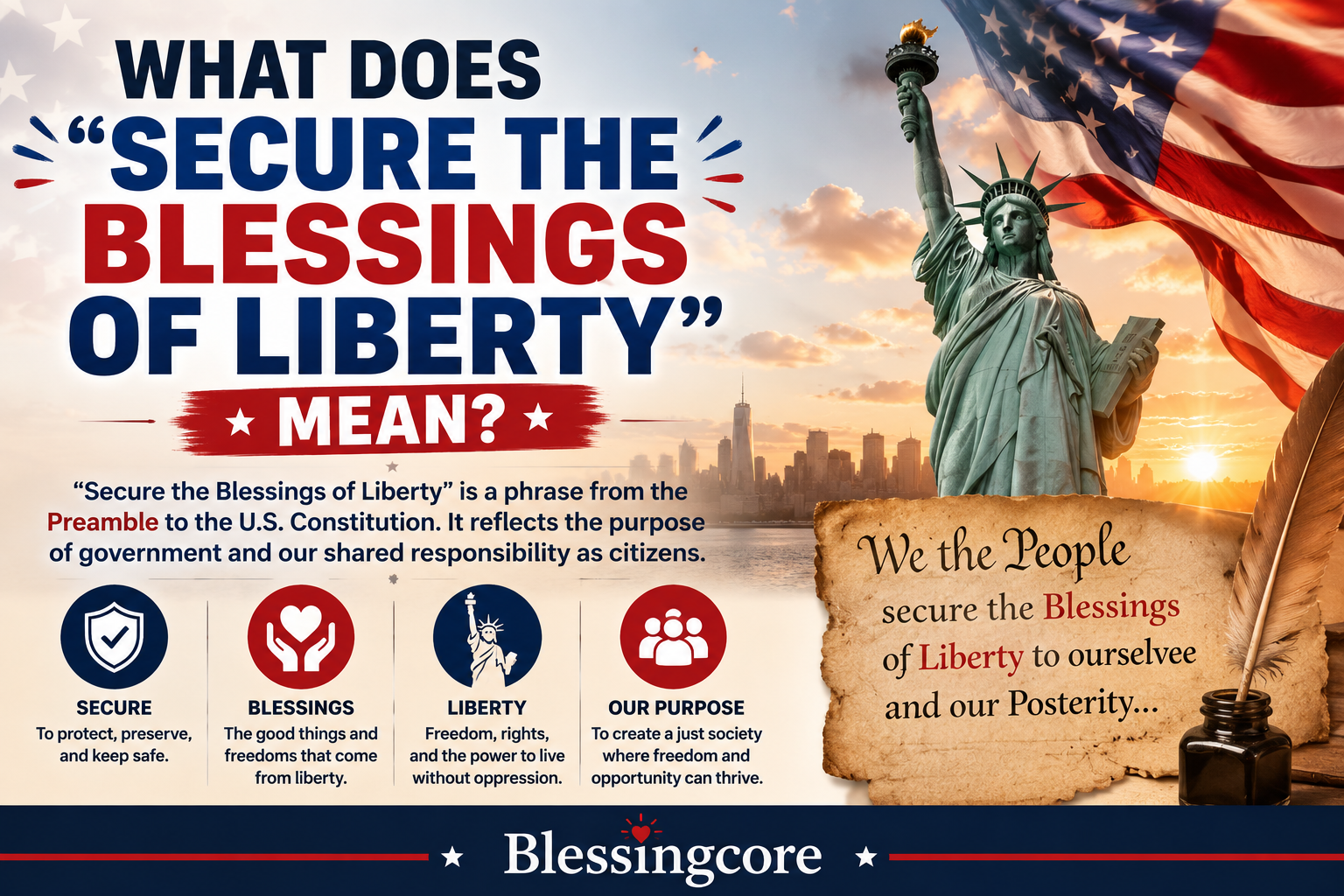
The phrase “secure the Blessings of Liberty” is six words long — but those six words carry the entire weight of American constitutional freedom. Tucked into the closing line of the Preamble, they represent a promise the Founders made to every American who would ever live under the Constitution.
At Blessingcore, we believe this promise is not a museum piece. It is a daily responsibility.If you have ever wondered exactly what the blessing of liberty means, where it comes from, and why it still shapes your daily life in 2026, this guide is for you.
We have researched the top sources on this topic, pulled together the most important ideas, and written everything in plain language — no law degree required.
What Does “Secure the Blessings of Liberty” Mean?
Quick Answer: “Secure the Blessings of Liberty” means the U.S. government is constitutionally required to actively protect individual freedoms — speech, religion, due process, equal rights — for both present-day Americans and every generation to come.
“Secure the Blessings of Liberty to ourselves and our Posterity” is the final goal listed in the Preamble to the U.S. Constitution. After outlining five earlier objectives — forming a union, establishing justice, ensuring peace, providing defense, and promoting welfare — the Founders placed the blessing of liberty at the very summit. It was the reason all the other goals existed.
Notice the specific word “secure.” The Founders did not write “create” liberty or “grant” it. They wrote secure — because they believed freedom was a natural right already belonging to the people. Government’s job was to guard it, not manufacture it on demand.
The blessing of liberty, as intended in 1787, is not a passive state. It is a living, active commitment from the government to the governed.
Understanding the Preamble and Its Purpose
The Preamble is the opening statement of the U.S. Constitution. At 52 words, it is one of the most carefully constructed sentences in American history. that was drafted in the summer of 1787 in Philadelphia by Gouverneur Morris, who worked from proposals generated by months of convention debate.
Crucially, the Preamble does not create laws, assign powers, or define rights. that explains why the Constitution was written at all. Think of it as a mission statement — the “why” that gives meaning to everything that follows.
| Preamble Phrase | Core Meaning | Role in Securing Liberty |
| Form a more perfect Union | Unite all states under one framework | Unity prevents the chaos that allows freedom to collapse |
| Establish Justice | Build fair courts and equal laws | Justice enforces the blessing of liberty when rights are violated |
| Insure domestic Tranquility | Maintain order and peace at home | Peace creates the conditions where freedom can be enjoyed |
| Provide for the common defence | Protect the nation from outside threats | Security is the foundation on which lasting liberty stands |
| Promote the general Welfare | Support the prosperity and wellbeing of citizens | Welfare ensures people can actually live their freedoms, not just hold them on paper |
| Secure the Blessings of Liberty | Protect freedom for present and future Americans | The ultimate goal — every other Preamble phrase builds toward this one |
The blessing of liberty comes last because it is the destination, not just another stop. Everything before it was constructed to support it.
The Meaning of “Blessings of Liberty”
Why did the Founders call freedom a “blessing”? The choice of word was intentional. Many of the Framers held religious convictions and believed liberty was not a government invention — it was a God-given inheritance.
Using the word “blessings” placed freedom in the category of sacred gifts to be protected, not political favors to be negotiated.
But what does the blessing of liberty actually include in practical terms? Here is how the Constitution defines it through the Bill of Rights and its subsequent amendments:
• Freedom of speech, press, and peaceful assembly (First Amendment)
. Freedom of religion and conscience (First Amendment)
• The right to a fair and speedy trial by jury (Sixth Amendment)
. Protection from unreasonable government searches and seizures (Fourth Amendment)
• Equal protection under the law regardless of race or background (Fourteenth Amendment)
. The right to vote and participate in choosing your government (Fifteenth, Nineteenth, and Twenty-sixth Amendments)
• Due process before the government can affect your life, liberty, or property (Fifth and Fourteenth Amendments)
These are not abstract ideals sitting in a history book. At Blessingcore, we stress that the blessing of liberty shows up in practical, everyday moments — which we cover in detail further below.
To Ourselves and Our Posterity: What It Really Means
One of the most forward-thinking elements of the Preamble is the phrase “to ourselves and our Posterity.” The Founders were not writing solely for the 3.9 million Americans alive in 1787. They were writing for you — and for every American who will ever live.
“Ourselves” referred to the living generation of 1787. “Our Posterity” meant their children, grandchildren, and all future citizens. This dual framing transformed the blessing of liberty from a one-time political gift into a generational inheritance.
The practical impact of this choice cannot be overstated. Because the Constitution was written with posterity in mind, it includes an amendment process — a mechanism for the blessing of liberty to expand over time. It was used to abolish slavery, extend voting rights to women, and guarantee equal protection regardless of race.
At Blessingcore, we see “ourselves and our Posterity” as a contract across time. You receive the blessing of liberty from those who came before you. You are obligated to protect it and pass it forward to those who come after. The blessing is not yours to own — it is yours to steward.
What Does Liberty Mean in the Preamble?
In the context of the Preamble, liberty does not mean unlimited personal freedom. It means ordered liberty — the freedom to live without oppression or tyranny within a legal system that applies equally to everyone.
This distinction is important. Pure freedom without law creates a situation where the most powerful people dominate everyone else. The Founders had lived through British tyranny and witnessed what unchecked authority looks like firsthand. They did not want to replace one oppressor with another.
So the blessing of liberty in constitutional terms means:
1. Freedom from government overreach, tyranny, and arbitrary rule
2. Freedom to speak, worship, assemble, and publish without interference
3. Freedom within a legal framework that treats every citizen equally
4. Freedom protected by institutions that prevent any branch from accumulating dangerous power
That fourth point is the reason the Constitution established three separate branches of government with a checks and balances system. Separation of powers is not just political architecture — it is the machinery that keeps the blessing of liberty functioning generation after generation.
The Founders’ Vision: Securing Freedom for All
James Madison, Alexander Hamilton, George Washington, and the other Framers arrived at the 1787 Constitutional Convention carrying fresh memories of British rule: taxation without representation, soldiers quartered in private homes, trials held without juries.
They were not writing theory. They were building protection against specific abuses they had personally suffered.
Their constitutional vision was this: create a government strong enough to protect the blessing of liberty, but structurally limited so that it could never become what they had just escaped.
Four design decisions made that possible:
• Separation of powers — dividing authority between the legislative, executive, and judicial branches so no single branch could dominate
• Federalism — splitting power between the national government and state governments to create an additional check
.The Bill of Rights — encoding the most critical freedoms directly into the Constitution’s text, making them harder to remove
• The amendment process — giving future generations the tools to expand the blessing of liberty as society and understanding evolved
The Founders’ vision was imperfect. The same people who wrote about securing liberty also wrote a Constitution that permitted slavery. But they built a system capable of correction — and that capacity for self-improvement is itself one of the blessing of liberty’s most important features.
How the Government Works to Secure the Blessings of Liberty
The Constitution creates specific institutions responsible for protecting the blessing of liberty day to day. Each of the three branches plays a distinct but complementary role:
| Branch | Core Function | How It Actively Secures the Blessing of Liberty |
| Legislative (Congress) | Makes the laws | Passes civil rights legislation, anti-discrimination laws, voting protection acts, and privacy statutes |
| Executive (President) | Enforces the laws | Appoints federal judges, directs enforcement agencies, and uses executive power to protect constitutional rights |
| Judicial (Federal Courts) | Interprets the laws | Strikes down unconstitutional laws, defends individual rights in court, and upholds due process protections |
Beyond the three branches, the Bill of Rights functions as a direct shield. The First Amendment protects free speech and religion. The Fourth guards against warrantless searches. The Fourteenth extended the blessing of liberty to all citizens regardless of race. Each amendment represents the Constitution fulfilling its core duty in a new context.
Contemporary examples of this protection in action include digital privacy rulings, freedom-of-speech enforcement on public platforms, federal voting-rights litigation, and whistleblower protection laws that allow citizens to expose government wrongdoing without fear of retaliation.
Examples of Securing the Blessings of Liberty in Everyday Life
You do not need to read a Supreme Court ruling to witness the blessing of liberty at work. It appears in ordinary moments throughout daily American life. Here are real, concrete examples most citizens encounter regularly:
| Everyday Situation | Blessing of Liberty Being Exercised | Constitutional Source |
| Voting in a local or national election | Right to political participation and self-governance | Art. I; 15th, 19th, 26th Amendments |
| Publishing an opinion without government censorship | Freedom of speech and press | First Amendment |
| Attending any religious service of your choosing | Freedom of religion and conscience | First Amendment |
| Enrolling children in public school | Access to education — a tool enabling fuller freedom | Established through 14th Amendment case law |
| Challenging a government fine or decision in court | Due process and right to a fair hearing | Fifth and Fourteenth Amendments |
| Peacefully protesting a law or government action | Freedom of assembly and petition | First Amendment |
| Locking your phone or home from warrantless search | Freedom from unreasonable government intrusion | Fourth Amendment |
| Starting a business without discriminatory barriers | Equal protection and economic liberty | Fourteenth Amendment |
Blessingcore reminds its readers: the blessing of liberty is not only in courtrooms or Capitol Hill. It lives in each of these daily moments. When citizens recognize that, they stop taking freedom for granted — and that recognition is what keeps it alive.
The Responsibility of Citizens in Preserving Liberty
The government cannot carry the entire weight of the blessing of liberty alone. Citizens are equal partners. Chief Justice Earl Warren wrote in 1955 that liberty is not a permanent possession — it must be earned by each generation through understanding, vigilance, and determination. That statement is as true today as it was then.
Here is what active citizenship looks like in practice:
• Stay informed — read credible journalism, follow court decisions, and understand the legislation that shapes your rights
. Vote consistently — local elections shape courts, schools, and law enforcement just as powerfully as national ones
• Defend others’ rights — the blessing of liberty protects people you agree with and people you disagree with equally; defending one strengthens both
• Serve your community — jury duty, civic boards, volunteer work, and community organizations all reinforce democratic institutions
.Hold leaders accountable — demand transparency and question authority rather than accepting abuses silently
• Teach the next generation — children who understand the blessing of liberty are far better equipped to protect it when their turn comes
At Blessingcore, we think of the blessing of liberty the way you think of a living garden. It grows beautifully when it is tended with care. Left unattended, it withers. History is full of societies where freedom eroded not through sudden collapse, but through years of gradual neglect by citizens who assumed someone else would protect it.
The Connection Between Liberty and Justice
The Preamble lists “establish Justice” and “secure the Blessings of Liberty” as two separate goals — but they are deeply interdependent. Neither can survive without the other, and the Founders knew it.
Justice in constitutional terms means two connected things: procedural fairness (you receive a fair process when your rights are at stake) and substantive fairness (the outcome genuinely respects your rights). When federal courts uphold due process, they are delivering both — protecting the blessing of liberty through the machinery of justice.
Remove justice, and the blessing of liberty becomes fragile. If someone’s rights are violated and no legal remedy exists, trust in the rule of law erodes and citizens lose confidence that freedom means anything at all.
Remove liberty, and justice becomes a hollow performance. A government can maintain courtrooms while suppressing the very freedom that allows citizens to challenge injustice in the first place. Only when both exist together does a society truly flourish.
This is not philosophical: it is structural. Every time a court enforces a constitutional right, it is performing both functions at once — delivering justice and securing the blessing of liberty simultaneously.
Why “Secure the Blessings of Liberty” Still Matters Today
The Preamble was written in 1787, but the duty it established does not have an expiration date. In 2026, the blessing of liberty faces challenges the Founders could never have imagined — yet the constitutional principles for addressing those challenges are exactly the same ones they built.
| Modern Challenge | Blessing of Liberty at Stake | Constitutional Anchor |
| Government and corporate digital surveillance | Freedom from unreasonable intrusion into private life | Fourth Amendment |
| Voting access restrictions and gerrymandering | Equal right to political participation | 15th, 24th Amendments |
| Censorship debates on social platforms | Free speech in modern public spaces | First Amendment |
| Housing and workplace discrimination | Equal protection and economic freedom | 14th Amendment |
| Misinformation and press freedom pressure | An informed citizenry able to hold power accountable | First Amendment |
| Online privacy and data rights | Personal security from warrantless data collection | Fourth Amendment |
Notice something about every challenge in that table: there is a constitutional answer for each one, because the Founders built a flexible framework rather than a rigid rulebook. The blessing of liberty was always meant to be applied to new circumstances, not just preserved as a historical relic.
“Secure the Blessings of Liberty” is a verb phrase, not a noun phrase. Securing is active. It requires intentional effort from the government, from the courts, and from every citizen. At Blessingcore, we believe the most powerful thing any American can do today is understand what that phrase means — and then live up to it.
Conclusion
The phrase “secure the Blessings of Liberty to ourselves and our Posterity” is not ceremonial language placed at the start of an old document. It is a directive — a clear, active mandate assigned to every branch of government and to every citizen who inherits the rights it describes.
The blessing of liberty includes free speech, religious freedom, equal protection, fair trials, the right to vote, and the right to live without government overreach. These freedoms were built into the Constitution deliberately and structurally. They require active protection in every generation — including this one.
At Blessingcore, we invite you to see the blessing of liberty not as history, but as daily responsibility. Every vote cast, every right exercised, every freedom defended for a neighbor — these are the acts that keep the Founders’ promise alive. The burden is shared, and so is the honor.
Frequently Asked Questions
What does “secure the blessings of liberty” really mean?
It means the U.S. government is constitutionally obligated to actively protect individual freedoms — including speech, religion, due process, and equal rights — for both citizens living today and every future generation of Americans.
What are real examples of securing the blessings of liberty today?
Voting in elections, publishing opinions freely, attending religious services, accessing fair courts, protesting peacefully, and being protected from warrantless searches are all daily examples of the blessing of liberty actively working in your life.
What does “to ourselves and our posterity” truly mean?
“Ourselves” referred to Americans living in 1787; “our Posterity” means every future generation — making the blessing of liberty a generational inheritance that each era must receive, protect, and pass forward.
How does the government actually secure the blessings of liberty?
Through the Bill of Rights, an independent judiciary, checks and balances, civil rights laws, voting protections, and constitutional amendments that have progressively expanded the blessing of liberty to more Americans across more than two centuries.
Why does securing liberty matter so much in modern society?
Because new threats — digital surveillance, voting restrictions, discrimination, and press pressure — emerge in every era, and without active protection from both government and citizens, even long-established freedoms erode gradually through neglect.
Must Read
110-romantic-text-messages-that-will-make-her-want-you-badly

Sophia, Mia is an experienced content writer with 500+ published articles on national and international platforms, specializing in SEO-focused, well-researched, and high-quality digital content.