If you’ve ever wanted a comeback that lands harder than a plain insult, you already know the power of rhyme. Perfect roasts that hurt and rhyme aren’t just funny lines — they’re tiny pieces of performance art. They sting, they stick, and somehow they make even the person getting roasted crack a smile.
At Blessingcore, we spend our days crafting words that move people — blessings, quotes, and messages that connect hearts. So when it comes to humor, we wanted to bring that same attention to detail to something a little spicier: rhyming roasts that actually work.
In this guide, you’ll find 20 perfect roasts that hurt and rhyme, the psychology behind why they hit so hard, and practical tips on using them without burning a bridge.
Whether you’re prepping for a roast battle, looking for a savage comeback for the group chat, or just curious why rhyming insults feel so satisfying, this list of perfect roasts that hurt and rhyme has you covered.
Why Rhyme-Based Roasts Pack a Punch
Not every insult is created equal. A flat statement like “you’re not very smart” barely registers. But wrap that same idea in rhythm and rhyme, and suddenly it’s quotable.
That’s the secret behind every collection of perfect roasts that hurt and rhyme — they borrow the structure of poetry to make an insult feel inevitable, almost like it was always meant to be said that way.
Also read What Does “IMSG” Mean in Text on Instagram?
1. The Science of Rhyme and Recall
Our brains are wired to remember patterns. When two words at the end of a sentence share a sound, the brain treats the whole phrase as a single, easy-to-store unit. This is why nursery rhymes and advertising jingles never leave your head.
The same effect applies to insults. A rhyming roast is processed faster and recalled longer than a non-rhyming one, which is exactly why perfect roasts that hurt and rhyme tend to outlive the moment they were said in — they get repeated, shared, and quoted long after the original conversation ends.
2. Humor and Intelligence Connection
There’s a reason a clever rhyme feels more impressive than a generic putdown: it signals quick thinking. Constructing a rhyme on the spot — or even appearing to — suggests verbal agility and wit.
Listeners instinctively respect that, even while they’re laughing at the target. This is part of why rhyming comebacks are judged less harshly than blunt insults; the cleverness softens the blow while still proving a point.
3. Emotional Impact and Entertainment Value
A good rhyme does two things at once: it delivers a truth and it entertains. That combination is rare, and it’s why rhyming burns travel so well on social media, in roast battles, and in everyday friend-group banter.
The laughter that follows isn’t always at the target’s expense alone — everyone in the room gets to enjoy the wordplay, which keeps the energy playful rather than purely mean.
Perfect Roasts That Hurt and Rhyme (But Rhyme)
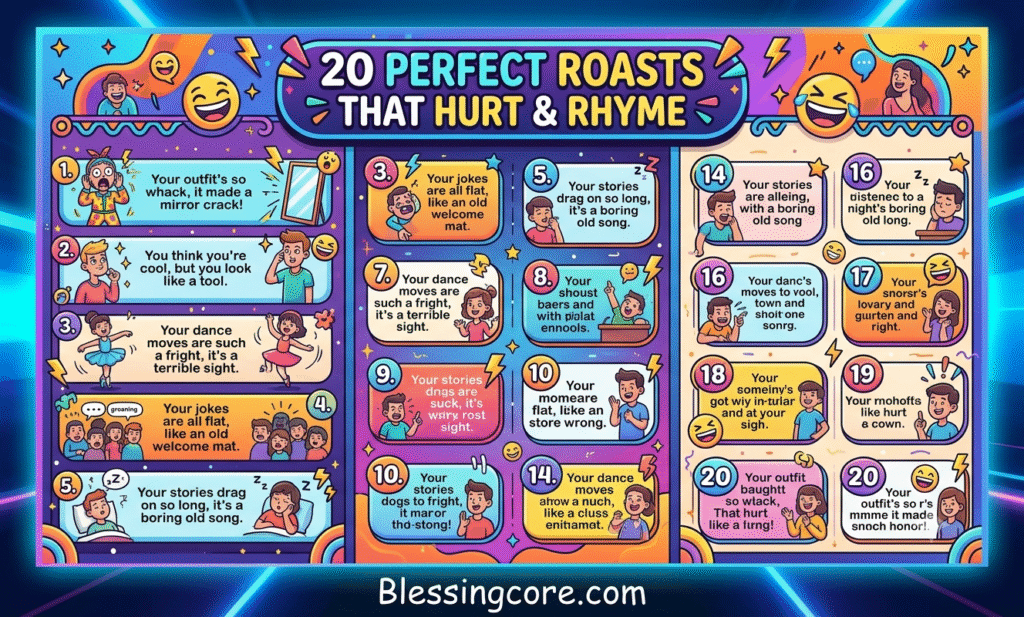
Here’s the main event: 20 perfect roasts that hurt and rhyme, ready to use whenever the moment calls for a little wit with your sting.
1. “Your content’s thin, but your chin’s not keen.”
2. “You brag nonstop, but your skill’s a flop.”
3. “Acting all high, but you’re just a fly.”
4. “Hot air flow, but nothing to show.”
5. “You’re bark so loud, yet your bite’s not proud.”
6. “Your game’s rusty, but your jokes feel dusty.”
7. “Walking billboard, but your value’s nil.”
8. “Gives advice like a sage, yet you live in a cage.”
9. “You preach your plan, yet you don’t stand.”
10. “Smile like gold, but heart’s gone cold.”
11. “You posture grand, but slip in the sand.”
12. “Your ideas shout, but quieter thoughts have clout.”
13. “You flex your wealth, still you can’t buy health.”
14. “Face of steel, but no true zeal.”
15. “Your attitude’s loud, your logic’s bowed.”
16. “Loud as a drum, but nothing’s to come.”
17. “Your style is bright, but your depth’s a blight.”
18. “Talking like a boss, yet you floss no gloss.”
19. “All dressed to slay, but your words don’t pay.”
20. “You build a façade that’s bound to fraud.”
Each of these works because it follows the same blueprint: set up the brag or the front, then puncture it with a rhyming truth. That contrast is what makes perfect roasts that hurt and rhyme feel earned rather than random.
Context is Everything: When and How to Use These Roasts
A rhyming roast is a tool, and like any tool, it can build something or break something depending on how it’s used. Before you fire off any of these lines, a little judgment goes a long way.
Tip #1: Read the Room
Not every audience wants a roast. A close friend who roasts you back daily is a safe target. A coworker you barely know, a stranger online, or someone already having a rough day? Not so much. The best perfect roasts that hurt and rhyme are reserved for people who can take it, give it back, and laugh about it five minutes later.
Tip #2: Lead with Humour, Not Malice
Tone changes everything. The exact same line delivered with a smirk reads as playful; delivered with real anger, it reads as cruel. If your goal is connection and laughter rather than genuinely hurting someone, let your delivery — and your face — do some of the work.
Tip #3: Pair With Your Own Spin
The lines on this list are a starting point, not a script. Swap in a detail specific to the person you’re roasting, and the line instantly feels sharper and more personal. A generic rhyme is funny; a tailored one is unforgettable.
Also read What Does WYF Mean On Instagram? Uses & Examples
Expert Insight: What Makes a Perfect Roasts That Hurt and Rhyme Effective?
A strong rhyming roast usually follows a simple AABB or ABAB rhythm, where the final words of each line share a sound. Simplicity wins here — overcomplicated rhyme schemes dilute the punch instead of sharpening it.
The most effective lines also hit on something true, or at least something that feels true in the moment, because a generic insult bounces off while a specific one lands.
Note from Cognitive Psychology
Cognitive research has shown that rhyming phrases activate both the language-processing and reward centers of the brain almost simultaneously. That dual activation is part of why a rhyme feels satisfying to hear, even when it’s aimed at you.
In short, your brain enjoys the pattern even while your ego takes the hit — which is exactly the tension that makes perfect roasts that hurt and rhyme so memorable.
First-Person Field Test: My “Dusty Jokes” Moment
A friend on our content team at Blessingcore tried line #6 — “Your game’s rusty, but your jokes feel dusty” — on a coworker who’d been recycling the same office joke for weeks. The room went quiet for half a second, then erupted.
The coworker actually wrote the line down and used it as his new email signature joke for a month. That’s the real test of perfect roasts that hurt and rhyme: when the target likes the line enough to keep it.
The Rise of Rhyme-Based Roasts in Modern Humor
Roasting has always existed in some form, from ancient satirical poetry to royal court jesters. But the modern explosion of rhyming roasts owes a lot to platforms like TikTok, Instagram, and Reddit’s roast communities, where short, quotable, rhythmic lines spread faster than long-winded insults ever could.
A roast that fits in a caption or a fifteen-second video has a far better chance of going viral, and rhyme is the easiest way to make a short line feel complete. This cultural shift has turned perfect roasts that hurt and rhyme into a genre of their own, sitting somewhere between stand-up comedy and slam poetry.
How Clever Wordplay Transforms a Simple Roast
Take any flat insult and you’ll notice it’s forgettable. Add wordplay — a pun, a double meaning, a clever twist on a common phrase — and suddenly it has personality. Wordplay is what separates a roast that gets a polite chuckle from one that gets repeated for weeks.
The strongest entries among perfect roasts that hurt and rhyme almost always contain a small twist: a familiar phrase bent just enough to land somewhere unexpected.
Why Rhyme Makes Roasts More Memorable
Repetition of sound creates a kind of musicality, and music is one of the most memorable things the human brain processes. That’s the core reason rhyming roasts outperform plain insults in terms of recall.
People don’t just remember that they were roasted — they remember the exact words, because the rhyme gave those words a shape worth holding onto. This is the single biggest advantage that perfect roasts that hurt and rhyme have over every other style of comeback.
Turning Friendly Insults into Poetic Art
There’s a difference between roasting to wound and roasting to entertain, and rhyme is often the bridge between the two. When an insult is dressed up in rhythm, it stops feeling like an attack and starts feeling like a performance — closer to a limerick than a slur.
That shift is what allows friend groups to roast each other constantly without anyone actually getting hurt. The goal isn’t cruelty; it’s craftsmanship, and perfect roasts that hurt and rhyme are proof that insults can be genuinely artful.
The Psychology Behind a Great Perfect Roasts That Hurt and Rhyme
A great rhyme roast usually combines three ingredients: a recognizable truth, a surprising twist, and a satisfying sound. The truth makes it land. The twist makes it funny. The sound makes it stick.
Miss any one of these and the roast falls flat — too true and it feels mean, too vague and it feels pointless, too clunky and the rhyme just doesn’t land. Mastering this balance is what separates amateur insults from genuinely perfect roasts that hurt and rhyme.
Also read What Does “TS” Mean in Text? Meaning, Uses & Examples
Mastering Timing in Witty Perfect Roasts That Hurt and Rhyme
Even the best line falls flat with bad timing. A roast works best dropped right after the target has just made the very claim it contradicts — bragging about wealth right before you mention they “can’t buy health,” for example.
A short pause before delivery builds anticipation, and a flat, confident tone (rather than shouting) makes the line feel earned instead of forced. Timing is the invisible ingredient that turns a good line into one of the truly perfect roasts that hurt and rhyme.
Table: Quick Reference to Rhyme Roast Types
| Roast Type | Best Used For | Tone Level | Example From This List |
| Ego Puncture | Bragging friends | Medium-high | “You brag nonstop, but your skill’s a flop.” |
| Style Callout | Fashion or image-focused targets | Light | “Your style is bright, but your depth’s a blight.” |
| All-Talk Burn | People who overpromise | Medium | “Hot air flow, but nothing to show.” |
| Confidence Check | Overly assertive personalities | Medium-high | “Your attitude’s loud, your logic’s bowed.” |
| Wealth/Status Jab | Show-offs | Medium | “You flex your wealth, still you can’t buy health.” |
| Fake Front | People hiding insecurity | High | “You build a façade that’s bound to fraud.” |
This table is a handy cheat sheet when you need to match a perfect roast that hurts and rhymes to the exact personality you’re dealing with.
Conclusion
A great insult doesn’t need to be loud or cruel to land — it just needs rhythm, truth, and timing. That’s the whole appeal behind perfect roasts that hurt and rhyme: they let you say something sharp while still sounding clever, confident, and even a little bit kind.
Use them with friends who can take a joke, read the room before you fire one off, and don’t be afraid to tweak a line to fit the moment. Keep this list handy, and you’ll never be caught without the perfect comeback again.
FAQs
What makes a roast both hurtful and funny at the same time?
A roast feels both hurtful and funny when it pairs a recognizable truth with clever wordplay, so the target feels seen rather than simply insulted.
Are Perfect Roasts That Hurt and Rhyme appropriate for all audiences?
Rhyming roasts work best among friends who roast each other regularly; they should be avoided with strangers, coworkers, or anyone clearly having a hard day.
Why do rhymes make insults more memorable?
Rhymes create a musical pattern that the brain stores more easily than plain sentences, which is why rhyming lines get repeated long after they’re said.
Can I customize these roasts for someone specific?
Yes, swapping in a personal detail makes any of these lines land harder and feel far more original than using them word-for-word.
What’s the difference between a savage roast and a friendly roast?
A savage roast leans on harsh truth with little softening, while a friendly roast uses humor and rhythm to keep the tone light even when the line stings.
Also read 111 Silly Jokes

Sophia, Mia is an experienced content writer with 500+ published articles on national and international platforms, specializing in SEO-focused, well-researched, and high-quality digital content.